
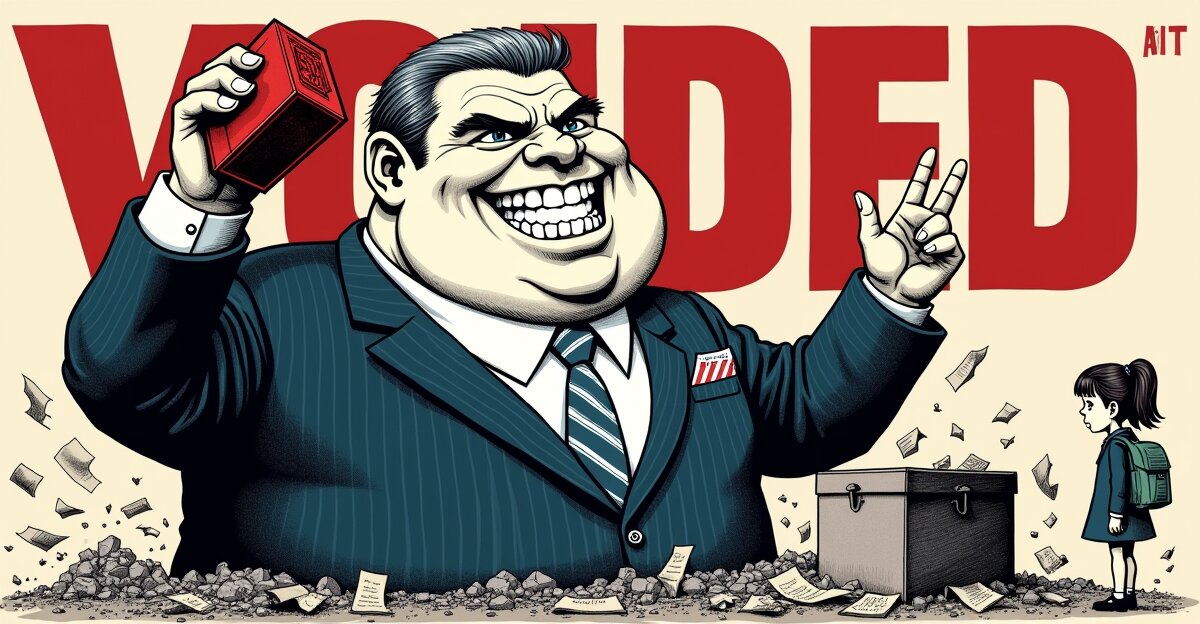
A defeated congressman had one trick left in his sleeve, and it forced his own party to go on the record about a war that killed 168 schoolgirls.
"All I know, all I can say, is that we're investigating that."
— Secretary of Defense Pete Hegseth, March 4, 2026, on the strike that killed 168 people, most of them girls, at an elementary school in Minab, Iran
On Tuesday, Rep. Thomas Massie of Kentucky stood at the rostrum for 67 minutes and read aloud, in its entirety, a 34-page document accusing the man who runs America's war of high crimes and misdemeanors. The resolution was filed as privileged, forcing a vote within two legislative days. Impeachment in a Republican-controlled chamber is a longshot. His goal, he said, was "a marker in history."
"Peter Brian Hegseth thus warrants impeachment and trial, removal from office, and disqualification to hold and enjoy any office of honor, trust, or profit under the United States," he read.
The centerpiece is a war that began on February 28, 2026. On the first day of "Operation Epic Fury," a U.S. bomb struck the Shajareh Tayyebeh girls' elementary school in Minab, southern Iran. At least 168 people died. The majority were girls between the ages of 7 and 12.
A preliminary assessment in March concluded the United States was "likely" responsible, though it did not intentionally target the school. In July, CNN reported that commanders had bypassed warnings about outdated targeting data and understood what had happened within days. In the articles, Massie charges that Hegseth ignored the laws meant to minimize civilian casualties, and closes with a line that reads less like an allegation than a conclusion: "By directing the Department of Defense in a manner that foreseeably dismantled the safeguards necessary to distinguish civilian objects from military objectives, Secretary Hegseth thereby effected the murder of civilians."
The Pentagon's own Inspector General agreed with the premise in a May 13 report: the Defense Department had systematically failed to implement its civilian harm mitigation plan, with all eleven objectives reclassified as "at risk." The Civilian Protection Center of Excellence had been stripped of key staff. The report was released redacted. The Minab investigation itself, which a CENTCOM admiral said in May was near its conclusion, has never been released. Reports say it was submitted, then stalled under review.
Hegseth's own words do the rest of the work. On March 2, he said Operation Epic Fury would have "no stupid rules of engagement," and described U.S. operations as "death and destruction from the sky all day long." A year earlier, the day Trump signed the order renaming the Pentagon the Department of War, he had supplied the department's motto: "Maximum lethality, not tepid legality. Violent effect, not politically correct."
Asked about the school in Minab, his answer was that he was investigating. Asked about the same school, the president's answer was that he didn't think it was us.
The other articles are an inventory of everything else the administration did without asking. A boat strike campaign across the Caribbean and the eastern Pacific, which the resolution labels extrajudicial killings. The capture of Venezuelan President Nicolás Maduro in early 2026, which it calls the "kidnapping of a sovereign foreign leader." The campaign of strikes on Yemen, documented in leaked Signal chats, with Brown University counting more than 200 civilian deaths.
One article is devoted to the strangest case of all: Hegseth's retaliation against Sen. Mark Kelly of Arizona, a retired combat veteran who told fellow veterans in a video, "You can refuse illegal orders." Hegseth answered with a letter of censure, a demotion bid, and a cut to his military retirement pay. A federal judge temporarily blocked the punishment in February. If allowed to stand, Massie writes, it would be "one of the most extraordinary expansions of Executive Branch power in the history of the United States."
Read together, the articles are less a legal filing than an accounting of six months of war, written by a member of the war's own political party.
To understand why this happened now, you have to understand why Massie can afford it now. Seven terms in, he is one of the most prominent anti-interventionists in Congress, which made him the member his party enjoyed attacking most. In May, he lost his primary to Ed Gallrein, a former Navy SEAL backed by Trump and bankrolled in part by pro-Israel groups. A week before the primary, the secretary of war drove to Kentucky to campaign against him and call him an obstructionist. "At some point, being against everything becomes an excuse for accomplishing nothing," Hegseth said.
Massie's recent career has been a single reflex: find the thing the party refuses to do, and do it anyway. With Rep. Ro Khanna of California, he led the successful push to release the Epstein files. When he began that discharge petition, House leadership canceled two weeks of the congressional calendar. He remembers.
"Frankly, I was concerned that Mike Johnson would end Congress again, like shorten even our already truncated work period if he found out I was doing this," Massie told reporters. "So I shared the idea with nobody."
He picked Tuesday because it was the last day a privileged resolution could still force a vote before the midterms. "Why today? Because Speaker Johnson has basically canceled the rest of Congress until the elections," he said.
"Doing this wasn't predicated on whether it could succeed or not; there needs to be a marker in history," he added, accusing the president and the secretary of war of exceeding "all norms for rules of engagement for how you use or misuse our military, to take oil from another country, to kidnap a foreign leader."
Translation: the articles were never going to pass. The point was the record.
The record never got made. By Thursday, the vote that House rules required had quietly disappeared. House Republican leadership canceled the calendar, including Massie's impeachment articles, and the House left for an extended recess that will not end until after the November 3 elections. There will be no vote. There will be no marker in history, at least not one with a tally attached.
The mechanics are worth pausing on, because the mechanics are the story. A privileged resolution is the House's own emergency brake: one member can force the chamber to take up a question it would otherwise never face. The Speaker's answer was not a motion to table, not a debate, not even a vote to kill it. The answer was a calendar. The House did not vote down the impeachment of its war secretary. It adjourned out of the room.
That is what a narrow majority buys you. Johnson's Republican edge is thin enough that he can absorb two defections before the math breaks. And the reason a symbolic vote frightened the majority is the polling, which is ugly. A Reuters/Ipsos survey found just 31 percent of Americans support military action against Iran, down from 37 percent in March. In the same week, Democrats led Republicans 44 to 37 on which party should control Congress. Trump's approval rating sits at a record low. The House has already passed two war powers resolutions on this war, with a few Republicans crossing over.
With every Republican having to defend the war in their own district before November, an impeach-Hegseth roll call is not a procedural event. It is a confession booth with a count.
The Pentagon's response arrived the same day. "Secretary Hegseth has been a transformative leader for the Department of War," press secretary Kingsley Wilson said. "Standards and merit are back, our arsenal is stronger than ever before and morale and recruitment across every service are at all-time highs. Secretary Hegseth has slashed bureaucracy, unleashed innovation and delivered for our warfighters every step of the way." The entire department, Wilson added, is unified behind the secretary's vision.
That is the official portrait of a war six and a half months old that has killed more than 1,000 Iranians and produced, by the account of its own inspector general, a civilian-harm machine in systematic decline. It turns out the one thing the department of "maximum lethality" cannot survive is not defeat on the battlefield. It is a yea and nay vote on the House floor, three weeks before its own members have to go home and explain a 34-page document they refused to hear.
The Minab investigation, reportedly complete, sits somewhere in the Pentagon under a CENTCOM review that has lasted months. The vote is waiting too, parked on a calendar that leadership can now edit at will.
The question was never whether the articles would pass. The question is what it says about a chamber that can be compelled to act but not compelled to show up. When the House returns in November, the vote will still be waiting. So, technically, will the 168.
Comments (0)
No comments yet. Be the first to speak up.
Join the Riot
Login with Google to leave a comment.
Login to Comment