
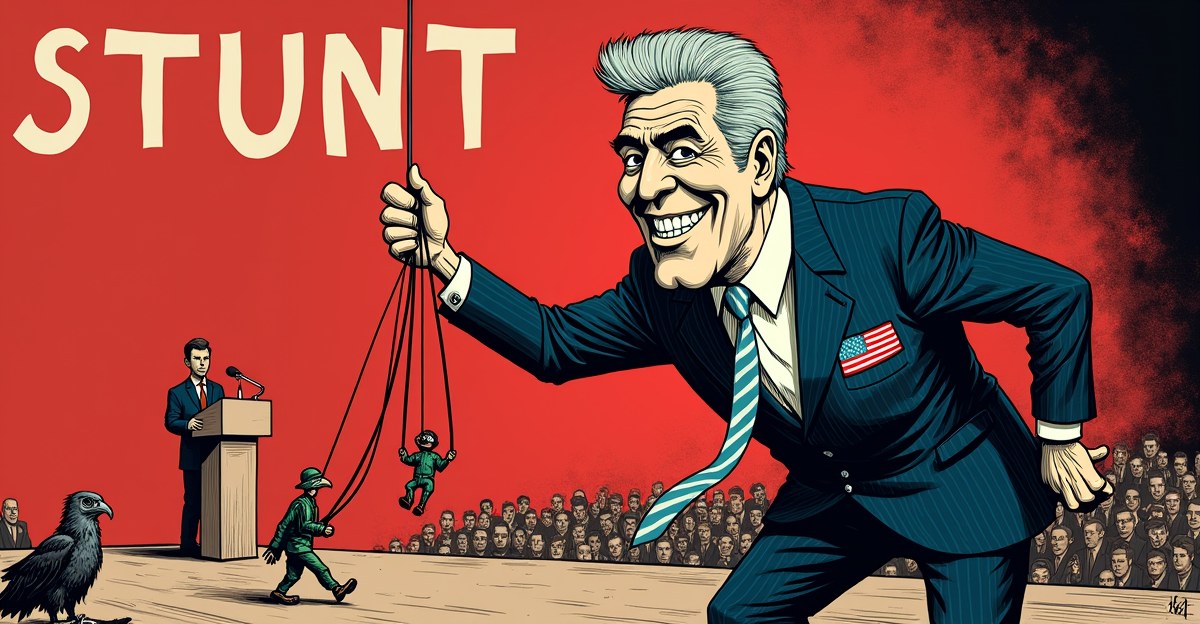
A tribute to the armed forces, interrupted: four airmen rappelled into a college stadium to entertain a crowd, and one of them never reached the ground.
"slid down the rope in an uncontrolled manner"
— San Antonio Express-News, on the final seconds of Saturday's pregame demonstration at the Alamodome
The fall happened on a Saturday night, during the kind of pregame show that college football still mistakes for a tribute.
Before the University of Texas at San Antonio and the Naval Academy took the field at the Alamodome, the stadium ran its annual Salute to Armed Forces and Veterans: flags, music, and four airmen rappelling from the rafters. The drop was roughly 170 feet, according to the New York Post. For a few minutes, the show went as rehearsed.
Then one of the airmen left the rope.
The San Antonio Express-News, the paper closest to the scene, described the last of it: he "slid down the rope in an uncontrolled manner" and hit the ground hard. Texas Public Radio, drawing on the San Antonio Report, reported that the stadium fell silent as medical staff attended to him on the field before he was carried away in a golf cart. The San Antonio Fire Department classified the hospital transport as Priority 1, a life-threatening emergency.
The game started about ten minutes late. Then it went on.
The Air Force confirmed Sunday that the airman died at a local hospital. He was assigned to Detachment 2 of the 6th Combat Training Squadron, a unit that operates out of Joint Base San Antonio-Camp Bullis, about 12 miles from the Alamodome. The parent squadron is based at Nellis Air Force Base, Nevada.
That detail matters, because it tells you what kind of unit this was. The 6th Combat Training Squadron trains Tactical Air Control Party airmen, the soldiers who embed with ground troops and direct airstrikes over a battlefield. Their job, when it is a job, is to be the human link between infantry in the dirt and fighter jets at the other end of the radio.
Translation: the unit that sends airmen to tell jets where to aim had, on a Saturday, sent one of its own up into a rafters to be a prop.
The Air Force has not released the airman's name. The base's entire public comment so far is a single line: "The incident is under investigation. More information will be released as it becomes available."
Video of the fall has circulated online since Sunday morning, and the worst part is not the fall itself. In the footage, the music keeps playing. The cheerleaders keep their routines. The crowd, as Military.com noted, looks confused, the way a crowd looks when a tragedy is too far away to understand and too close to look at.
UTSA issued a statement the same night. "We are deeply saddened by the incident that occurred at the start of tonight's football game," it read. "Our heartfelt thoughts and prayers are with the soldier who was affected, his family and his military colleagues."
The game, in case it helps you understand the arithmetic: UTSA beat Navy, 38 to 34, in their first ever meeting. A college football box score, completed and filed, the same night a young service member was dying in a hospital twelve miles from his own base.
Nobody has explained why four airmen were up in those rafters.
Military pregame demonstrations are a decades-old tradition: parachute jumps, rappels, flyovers, a human scale model of the force. The Air Force has performed in football stadiums for as long as football has needed a pregame. None of it is inherently fatal. All of it is a risk decision, and risk decisions require an owner.
Who requested the demonstration? Who approved it? What did any risk assessment say about a 170-foot drop over a live crowd? What was the point, specifically: recruitment, goodwill, a clip for social media, a nod to the service members in the stands? None of those questions has been answered, not by the Air Force, not by the university, not by the Department of War. As of Sunday evening, the story is a body bag, a boilerplate statement, and a silence where an explanation should be.
The Daily Beast understood the shape of the story fast enough to headline it where it points: "Hegseth Ripped for 'Pointless' Military Stunt That Killed Airman," under a kicker that read "Tragic Spectacle."
The framing is not unfair, and the timing is not an accident. On September 30, seventeen days before the fall, Secretary of War Pete Hegseth convened roughly 600 junior officers and enlisted leaders at Quantico for a "State of the Force" address he intends to make an annual tradition. He called for a "warrior ethos." He announced a new autonomous weapons command. He staged the military, which is to say he did what the Department of War under his watch has increasingly done: turned the force into a production, and the production into the message.
And here is the part that should be the loudest part. In the days since the fall, nobody in Hegseth's office has said a word. No statement, no condolences, no promise of a review. The only voices in the record are the base public affairs line and the university's grief.
A Pentagon that has built a brand on performing the military now has a casualty to perform around.
The airman's name has not been released, and the investigation will take weeks, at least. But the structure of the story is already complete, and it is the structure the probe will spend its time confirming: a young service member, a short drive from his own base, strapped into a harness above a football field on a Saturday, performing a salute that needed a 170-foot drop to look impressive.
The question is not what broke in the fall. The investigation will say whether it was the rope, the harness, the anchor, or a person. The question is what the fall was for. A tribute to the armed forces that ends with an airman on a stretcher has stopped being a tribute. It is an advertisement, and the price was posted on the field.
For now, the Department of War's entire response is a single word: investigation. The salute is over. The show, apparently, can resume.
Comments (0)
No comments yet. Be the first to speak up.
Join the Riot
Login with Google to leave a comment.
Login to Comment