
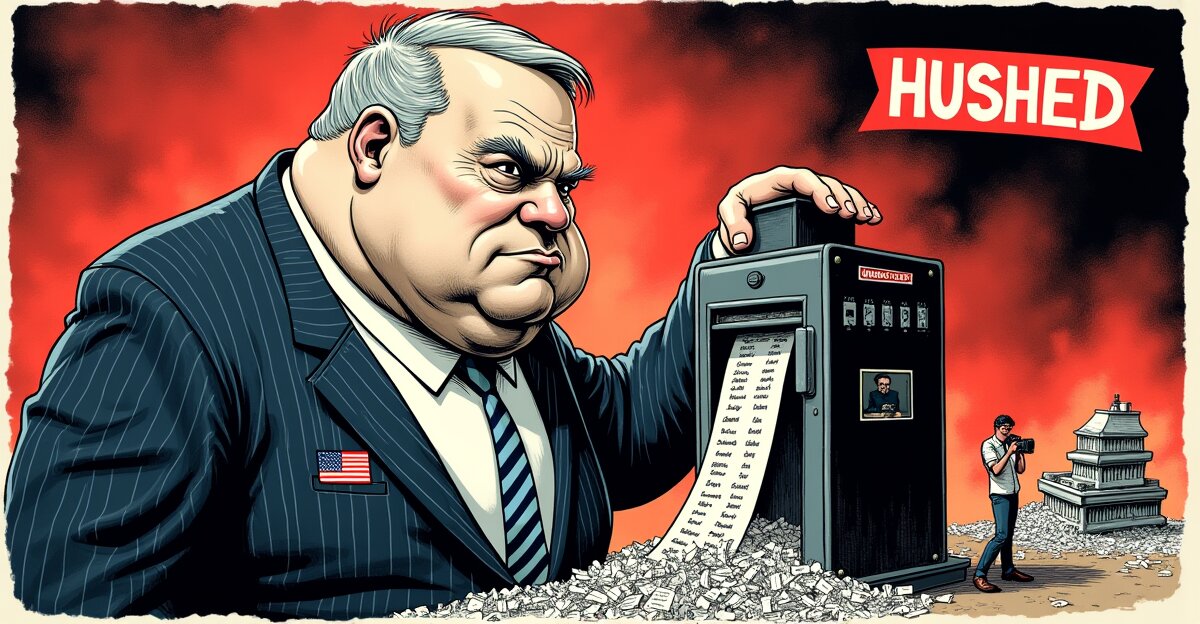
The War Department added a body to its own ledger, told almost no one, and is now showing the one number that makes the war look the least bad.
"They want to tell you that the war is going fine, and they want to believe that, and it's going to plan, and sometimes they're able to say that because they're not counting the casualties that are in the rear. It's politically useful."
— Neta Crawford, co-founder of Brown University's Costs of War Project
On Monday the Pentagon did something, and on Tuesday it did not do something else. It quietly added a name to its public casualty database. It did not announce the death. The name is Bianca C. Wilkerson, 37, of Norfolk, Virginia, deployed to Doha, Qatar, in support of operations against Iran. She died Friday of an undisclosed "medical incident" aboard a non-combat flight to Saudi Arabia. She is the war's nineteenth officially acknowledged American death.
For a day, at least, the machinery of the American war knew a soldier was dead and the country did not.
That distinction matters, because the number 19 is not a fact the way a war produces facts. It is a figure that has been moved, relabeled, and nudged for six months. The war began February 28, when the United States and Israel opened strikes on Iran in an operation the Pentagon calls Epic Fury. It has now killed more than 3,400 civilians in Iran, by United Nations accounting, and wounded more than 33,000. On the American side it has produced over 850 casualties, and the official list of the dead has a hole in it.
The trick is in the labels. Since July 7, the Pentagon has stopped counting these casualties under the war's real name. It now files them under a generic line called "Overseas Operations." The switch happened at the moment the administration claimed Operation Epic Fury was over, even though the war is not over, even though the Strait of Hormuz is still shut and the fleets are still locked in a counter-blockade.
The relabeling is not bookkeeping. It is a workaround. The Constitution does not let a president start a war without the approval of Congress, and the War Powers Act of 1973 gives the executive a hard 60-day deadline to get it. If the fighting is no longer "Operation Epic Fury," the administration reasons, then the deadline is a problem for a different war. Secretary of Defense Pete Hegseth told Congress in April that a ceasefire "pauses" that deadline. Legal scholars pointed out that the argument is nonsense, and that no amount of renaming makes an unauthorized war legal.
The labels reach the families, too. A widow of an Air Force member killed in March said the military denied her death benefits because an officer told her "we have not declared war." When her story went public, the Air Force said it was reviewing the case, and the problem was resolved.
Translation: the same death can be a war death for the news and a non-war death for the check. Which one you are depends on which form you fill out.
The numbers have a history of moving on their own. On April 21 the count of troops wounded in action dropped by fifteen, with no explanation from the War Department. The Pentagon has not answered repeated questions about the discrepancies. One government official told The Intercept that scores of casualties added to the database last month were "an accounting trick" designed to dampen depressing statistics, and that the Pentagon had been "slow-walking" the total for weeks. "They wanted the heat on them to slow down after the really devastating attacks," the official said, referring to the July strikes on U.S. bases that exposed just how vulnerable the troops were.
The official statistics now show 352 personnel wounded or killed in July, and none in August. In a war that has not paused, a perfect zero is not a result. It is a choice.
The list of the dead is missing names, too. Major Sorfly Davius, a signals officer in the New York Army National Guard, died in Kuwait in March. The chairman of the Joint Chiefs honored him to a room of generals and then the official count left him out. Sergeant Devin Seibel died in a training accident in Iraq in May, and he is missing from the list as well. Three American contractors in the region have died and are not on any list at all. A Washington Post review, based on six officials with access to the data, put the real American death toll at 22 or 23.
The Pentagon's deputy press secretary did not answer requests for comment. The dead, as it turns out, do not need a spokesperson.
This is the part that should be the scandal, and is not. The United Nations has accused the United States of war crimes and crimes against humanity in this war. Two UN reports called out specific American actions: the strike on an elementary school in Minab that killed more than 160 people, including 123 children; the boat-strike campaign known as Operation Southern Spear; and a February strike on a sports facility in Lamerd that killed 22 civilians. Both reports named a single American official as bearing responsibility for the country's dismissal of the international laws on civilian harm.
His name is Pete Hegseth.
Last week, Representative Thomas Massie of Kentucky, a Republican, filed articles of impeachment against him. Massie charged Hegseth with violating the War Powers Act three times and with openly ignoring the laws meant to minimize civilian casualties. He filed the articles as a privileged measure, which would have forced a full House vote on September 17. Speaker Mike Johnson and the GOP leadership cancelled that day's proceedings and adjourned the House a day early, sending the chamber to recess until after the midterms. The vote is not delayed. It is postponed to a date that may never arrive.
A YouGov poll released this week found that 51 percent of registered voters say Hegseth should be impeached for starting a war with Iran without authorization from Congress, against 34 percent who say he should not. The support is strongest among liberals, but roughly one in five MAGA Republicans and conservatives back it, too. Massie posted the number to social media and said it plainly. Public support for the impeachment, he wrote, "is why [Johnson] adjourned Congress to avoid the vote."
A war that is six months old, that has not been authorized, that is being relabeled to dodge the one branch of government supposed to check it, and that keeps a death count it does not want you to see. The numbers are not the story. The numbers are the whole story. They are what the war actually is, written down.
The question is not whether the Pentagon is hiding the body count. The question is what it thinks a number is for, and the answer, in every month of this war, has been the same. A number is for the war to look like it is going to plan. It is politically useful. The dead are the part of the spreadsheet that does not fit, so they are filed under a different name, or not at all.
The War Department says nineteen. The country can keep the difference, or it can ask why the number that matters most is the one it gets to choose.
Comments (0)
No comments yet. Be the first to speak up.
Join the Riot
Login with Google to leave a comment.
Login to Comment