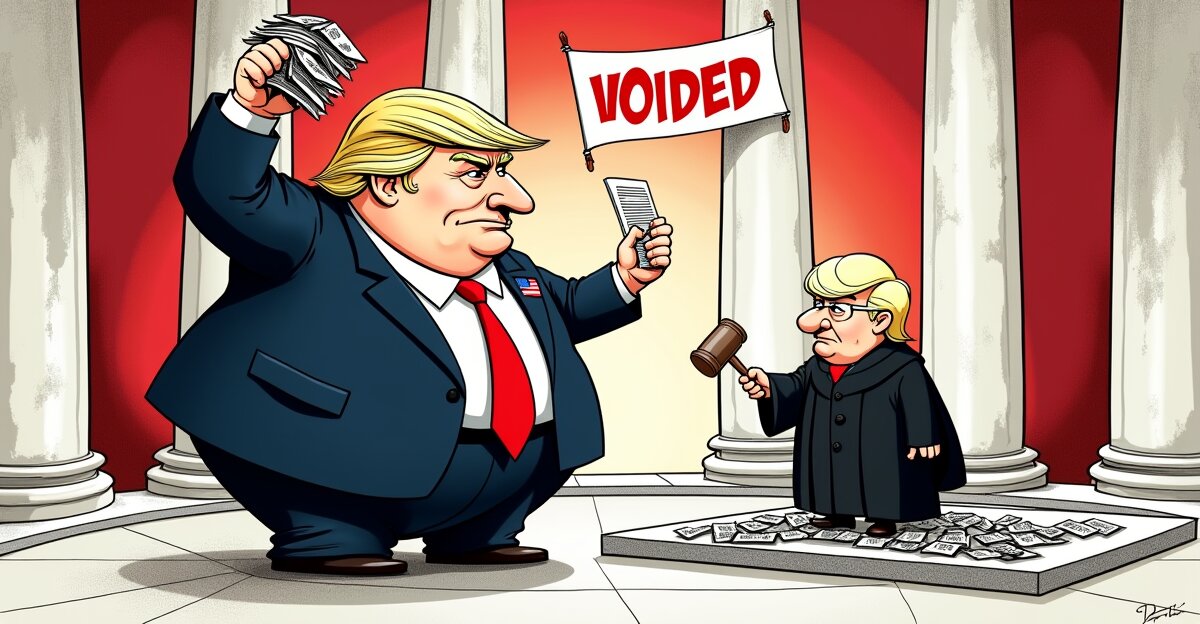
On Thursday, a judge appointed by Donald Trump ordered the White House to hand back three newsrooms' press badges, and the White House spent most of the day holding onto them, on the day Xi Jinping was in town.
"Nothing in the record suggests that the revocation of Plaintiffs' hard passes was motivated by national security concerns."
— U.S. District Judge Timothy Kelly, in the order that struck down the White House press ban
The order went out in the early hours of Thursday morning, and by Thursday afternoon the three newsrooms it was meant to protect were back through the White House gates, badges reactivated. In between, the American press corps spent the most high-profile foreign visit of the year on the outside, and the government's lawyers kept a federal court order in a drawer for a spell.
The part of that sentence worth reading slowly is the judge's name. Timothy Kelly was not an activist who wandered into the E. Barrett Prettyman Federal Courthouse on a whim. He was nominated by Donald Trump in 2017. In 2018, the same judge ordered a CNN reporter's access restored after the first president tried to bar him. On Thursday, that man restored the access of CNN, MS NOW, and Politico in a two-week temporary restraining order that found the ban likely unconstitutional.
To understand why the White House defied the order for hours, you have to rewind to Friday, September 18. Trump announced the ban in a Truth Social post, saying he was stripping the three outlets "as a result of their constant 'reporting' [of] FAKE NEWS!" By Saturday, correspondents from all three organizations had arrived at the building where they covered the presidency for years to find their credentials confiscated and their access revoked. Over the weekend, the justification upgraded itself: what had been "fake news" was now "a threat to our National Security" that "must be stopped."
What had the three organizations actually done? According to the government's own filing, CNN reported on a bunker beneath the planned East Wing ballroom, MS NOW reported on the White House's internal investigation into leaks, and Politico reported on Secret Service money being used for ballroom security. Elsewhere, the outlets reported on a congressional investigation into classified F-35 technology and China, and on a near-war that almost happened because the U.S. military believed an AI-generated account of a Chinese ship. The government's answer to all of that was: that is why the badges came off.
On Monday, the three newsrooms sued, calling the ban a "blatant violation" of the First Amendment. Some 50 organizations, from the Associated Press to the Freedom of the Press Foundation, lined up with amicus briefs. On Wednesday, the case went to a hearing, where Theodore Boutrous Jr., the outlets' lawyer, told the judge the ban was causing "irreparable harm." "We're at war," he said. "We have world leaders coming to Washington." Michael Velchik, the Justice Department's senior counsel, answered with the line the weekend had produced: "Access to the White House is a privilege, not a right."
The filing carried the national security argument, plus a side complaint that the three organizations leaned on anonymous sources. That part did not survive contact with the documents it was built on. Among the examples the DOJ offered was MS NOW's August report that the Iran conflict had "significantly depleted" the U.S. military's munitions supply. The outlet's source for that claim was a document published in the Federal Register. And according to Status News, the anonymous source for at least one story the White House cited was Vice President JD Vance, who in June had briefed reporters on background about negotiations with Iran. Ryan Goodman of Just Security called the reporting "core First Amendment protected reporting."
Translation: the government's best evidence of dangerous journalism was a story whose source was the vice president.
Kelly's order was not gentle. The government, he wrote, must have clear standards for revoking a press pass, and the standard the White House laid out in its letters to the outlets was "so vague it hardly does the trick." He noted, almost as an afterthought, that Trump never once invoked national security when he announced the ban, only what he called negative coverage. The order told the White House to "immediately return, reinstate, and restore" access, held the ban likely unconstitutional under the Fifth Amendment's due process clause, and set October 5 for briefing on a longer preliminary injunction. Kelly, the order said, "intends to rule expeditiously."
The irony is structural, and it should not be missed: the only check fast enough to catch this ban was one the administration itself hired. Trump's own personnel file produced the judge who struck down Trump's policy. The Freedom of the Press Foundation notes that Trump lost two similar prior-restraint cases in his first term, and that the 1971 Pentagon Papers decision told the government it could not shut a newspaper down. The Justice Department argued all of it anyway.
But the order said one thing, and the White House did another, for most of the day. On Thursday morning, reporters from the three organizations were still turned away at the gates. MS NOW's White House correspondent Laura Barrón-López had her badge confiscated and was told by a Secret Service agent that her credentials were "still coming up as disabled" in the White House's system. CNN's Elie Honig called the scene "Absolutely in Defiance of the Judge's Order!" The outlets requested an emergency hearing.
In a court filing, the administration explained the delay with a specificity that reads like a cover story. Operations staff had been notified of the ruling, but they "needed time to find, reactivate and deliver" the badges. The process took over two hours. Seth Stern, chief of advocacy at the Freedom of the Press Foundation, put it plainly: "Court orders are just paper unless they're enforced."
Translation: on the day the country's most powerful man hosted the world's second most powerful man, the White House spent two hours looking for plastic badges.
Meanwhile, the other half of Thursday was a story about what the country got to see. Since Monday, the other four networks in the five-network video pool rotation had refused to shoot pool video while CNN was shut out, and after the ruling they kept refusing. When the president formally welcomed Xi at Joint Base Andrews, crews from Fox News, CBS, and NBC stood on the lawn with tripods set up and cameras off. The AP, an amicus in the case, told its customers it would not stream independent video of the meetings. On the day the president hosted a head of state and planned a state dinner, the American public got to watch on the White House's own live feed, or on the feeds of the smaller outlets that were not banned.
The press pool is not a favor. It is how a democracy watches its own front door, and for one day the front door was watched only by the government's own cameras. An Economist/YouGov poll published the day before the hearing found that 58 percent of Americans disapproved of the ban, and 49 percent strongly disapproved; 32 percent approved. That is the number to hold onto, because the ban, the defiance, and the two-hour badge search did not move the country toward the White House's side.
What happens next is procedural, and therefore watchable. The two-week restraining order expires in two weeks, briefing on the preliminary injunction is due October 5, and Kelly has promised to rule expeditiously on whether the three newsrooms stay inside for the life of the case. If the White House defies that, too, the next step is contempt, the remedy Stern asked for on Thursday.
The White House said access was a privilege, not a right. A judge appointed by the man it serves said a privilege cannot be taken back without due process. And the administration, in the end, conceded the one point that mattered: the badges were coming back. The only question the two-hour delay answered is the one this country should not have to keep asking. How long does it take the White House to find what the law has already told it to give up?
Comments (0)
No comments yet. Be the first to speak up.
Join the Riot
Login with Google to leave a comment.
Login to Comment