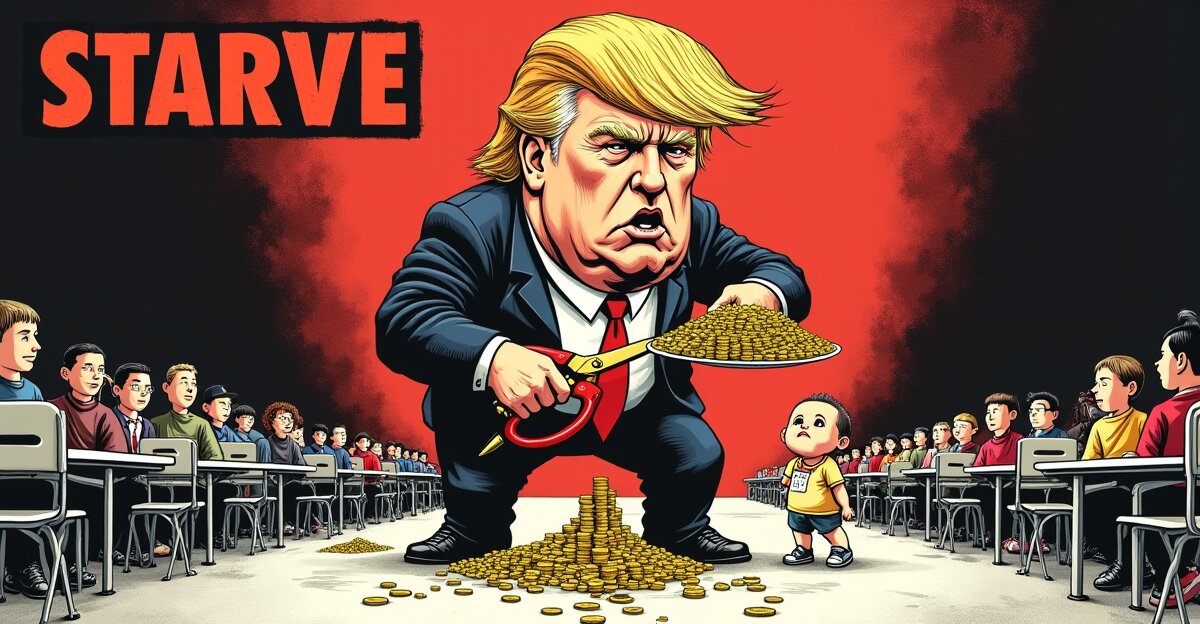
A law meant to shrink the federal budget is quietly deciding which American children eat at school.
"Cuts to SNAP are not going to stop at the grocery store. They really are going to threaten children's access to school meals, which is obviously going to increase hunger at home and in the classroom."
~ Clarissa Hayes, deputy director of child nutrition programs at the Food Research & Action Center
On the first day of the new school year, a lot of children in the United States quietly stopped being automatically fed.
They did not get a letter. No one put a red mark on their record. The change arrived inside a spreadsheet: a drop in household SNAP enrollment, the same data that school districts use to determine how many kids eat free. When that number falls, schools fall with it. And this is the first August since 2025's One Big Beautiful Bill Act that it has fallen this fast.
Between May 2025 and May 2026, more than 5.6 million people lost SNAP coverage, according to the latest federal data. That is a 13.5 percent drop in a single year, faster than the nonpartisan Congressional Budget Office projected when it scored the legislation. Roughly 36.6 million people received food stamps in May, on an average benefit of about $187 a month per person.
The number that matters most for cafeterias is the one attached to children. About 1.5 million of the people who lost SNAP coverage are kids, and they are the ones whose free breakfast and lunch were being handed out automatically, on paper, before they even reached the counter.
Translation: the biggest entitlement cut in a generation is not showing up on a ballot or in a headline. It is showing up as a shorter line, and a quieter lunchroom.
The mechanics are buried in a federal program called the Community Eligibility Provision. Under CEP, a school that serves a high enough share of low-income students can offer free meals to every child in the building, with no means-testing, no stigma, and no family income documentation. In the 2025-2026 school year, a record 55,362 schools nationwide used CEP, and nearly 28 million children attended one.
The catch: CEP eligibility and the federal reimbursement it generates are both calculated from the same rolls that SNAP feeds. Drop SNAP participation and a school's certification rate drops with it. The system that was supposed to shield the poorest children from stigma has a built-in tripwire, and the tripwire is now being pulled.
It is already happening. This summer, Miami-Dade County Public Schools, the largest school system in Florida, announced it would no longer offer universal free meals across its 500-plus schools because its federal reimbursement eligibility had shifted. Free meals survive in 121 of them. In the rest, children who were eating for free must now individually apply, a process that demands income paperwork and carries a stigma that universal feeding was created to erase.
In Marion County, Kentucky, nutrition director Jennifer Wheeler says the district's four-year certification would have covered about 93 percent of students. Current SNAP enrollment would cover about 75 percent. For a self-funded district with 3,000 students and no local tax base, that gap is not a line item. It is the difference between opening the kitchen and closing it.
The summer feeding line told the same story in numbers. The same program, the same logistics, the same prepackaged meals: 134,000 handed out last summer, more than 201,000 this one.
The families feel it first. Anthony Bonner, a Memphis barber, lost his $250 monthly SNAP benefit in March when a federal change ended the work-requirement exemption for parents of children 14 and older. His contract job does not satisfy the new requirements, so he feeds himself on ramen packets and frozen vegetables, and he lets the school feed his 14-year-old son.
"It's one thing to cut me off, but I should have been able to get benefits for him," he told Stateline. "I still have yet to really have enough food that I feel comfortable with that me and my son can eat for the month."
A No Kid Hungry survey released last month found that close to 60 percent of parents said their child would not have enough to eat without the meals served during the school day. A quarter of public schools now serve universal free meals. The bill that is dismantling the pipeline is, in effect, dismantling the safety net that makes those meals affordable.
Democrats are trying to get Congress to move before the school year fully takes hold. Rep. Raja Krishnamoorthi (D-Ill.) wrote to the USDA that "no child should lose access to breakfast or lunch at school because a parent was unable to satisfy a new bureaucratic requirement for food assistance," and that "no school should be forced to jeopardize its meal program because federal policy has made it harder to identify children who qualify."
The White House did not respond to questions about how the SNAP changes would hit school meals. Neither did a spokesperson for the Senate agriculture committee that oversees the program.
Translation: the administration has a position on this, it is simply not speaking it.
The irony is structural, not incidental. Universal free school meals were an achievement, a quiet one, that removed the shame of the lunch line and improved attendance and learning for millions. The same law that gutted the data behind that achievement is being defended as an act of fiscal discipline, of cutting waste and fraud.
The question is not whether the cuts were intentional. The question is why the people who made them were not surprised that a spreadsheet built to protect the poorest children was also the one that would betray them.
This story draws on reporting from Stateline, Common Dreams, and the Food Research & Action Center.
Comments (0)
No comments yet. Be the first to speak up.
Join the Riot
Login with Google to leave a comment.
Login to Comment