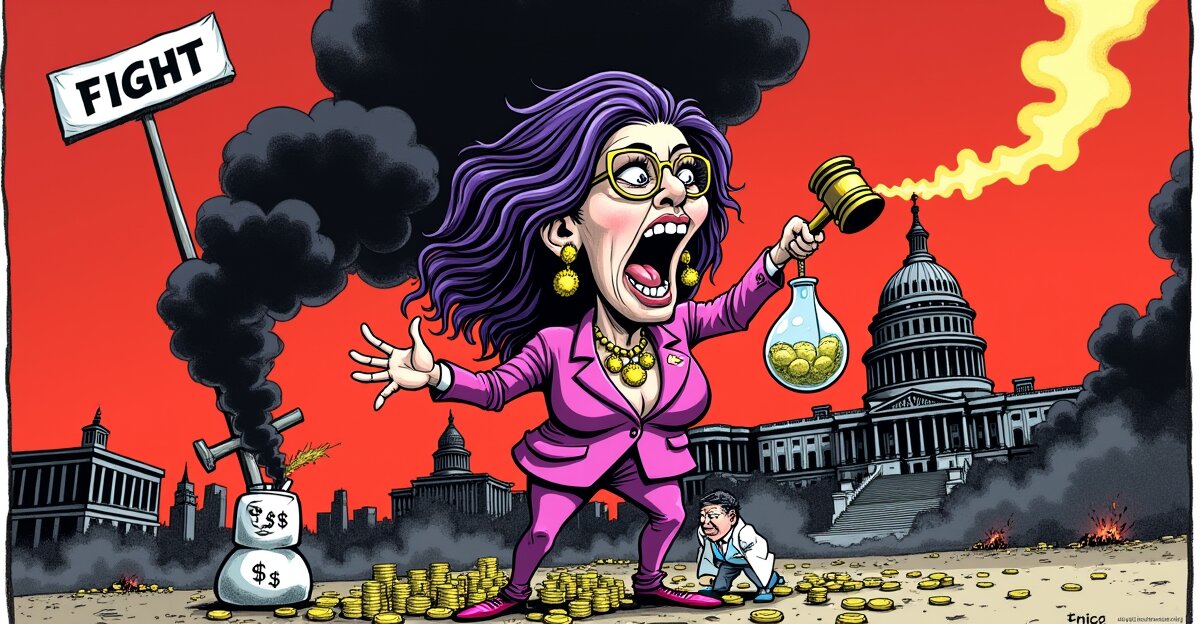
An administration running out of money for a war it never got permission to start has reached, without telling anyone, into the science budget meant to cure disease.
"This secretive attempt to siphon research funds away from NIH is outrageous. The interagency agreement needs to be terminated immediately."
— Rep. Rosa DeLauro (D-Conn.), top House Democratic appropriator
The United States government, in the middle of an open-ended war it is losing on cost, has quietly decided that the money Congress set aside to research cures for HIV, influenza, and tuberculosis is a fine place to find extra money for bombs.
The arrangement was buried inside an interagency agreement between the Department of Defense and the National Institutes of Health, signed without notifying lawmakers or the public. The Pentagon would gain access to billions in funding earmarked for the National Institute of Allergy and Infectious Diseases, a unit that burns through roughly $7 billion a year on biomedical research. It is not even clear that NIH agreed to the deal.
Rep. DeLauro, the top House Democratic appropriator, was the first to speak about it, and she did not go gentle into it. "These funds were provided for lifesaving medical research, not as extra money for the Department of Defense," she said. "It is no secret that the Department of Defense is facing enormous financial pressure because of President Trump's war of choice with Iran. But the Trump administration cannot make American patients, families, and scientists pay the price."
The story broke late Thursday. By Friday, the words "secret," "siphon," and "outrageous" had settled comfortably into the news cycle, which is to say: this is not news that anyone is defending.
The background is what makes it ugly. The Pentagon has publicly put the cost of the Iran war at around $37.5 billion so far, a number the department, which has never passed an independent audit in its entire existence, has released without any full accounting. Experts who have seen the books call the figure a gross undercount. On top of an annual defense budget already exceeding $1.1 trillion, the administration is now asking Congress for a $67 billion supplemental to cover more of the war's tab.
Military spending already eats roughly half of the federal discretionary budget. When that machine runs hotter, it does not simply borrow from an empty room. It raids the next room over.
Translation: when the defense budget hits a wall, the NIH is where the wall used to be.
The administration's own defense of the deal reads like a man describing a fire by the light of the arson. A Trump administration spokesperson told The Hill that the Pentagon-NIH arrangement would "enable nimble multi-agency resources to collaboratively respond to public health emergencies, such as the recent Ebola outbreak."
Leslie Dach, chair of the advocacy group Protect Our Care, asked the question no one at the White House wanted to hear out loud. "Given Secretary Hegseth's history of lying through his teeth about our national security and the fact this budgetary sleight of hand was reluctantly revealed to Congress, would anyone be surprised if these raided NIH funds were actually intended to buy more bombs?"
She said the deal "at the expense of public health needs to be revoked immediately, followed by a serious congressional investigation into the extent of and motives behind the Trump administration's taxpayer money shell game."
Sen. Patty Murray (D-Wash.), the Senate Democrats' top appropriator, was less interested in motive and more interested in what was already being spent. "As if canceling lifesaving medical research and clinical trials and firing cancer researchers en masse were not bad enough, the Trump administration is now trying to rob NIH of billions of dollars that Congress provided for medical research so that it can pad the Pentagon's budget," she said.
The pattern is consistent enough to feel choreographed. Cancel the research, fire the researchers, then reach for the remainder of the pot.
What makes this particular theft different from the usual budget fights is the secrecy. Congress appropriates money for a reason, writes down that reason in a bill, and signs it into law. The NIH funds were appropriated to study HIV, influenza, tuberculosis, and other diseases. The agreement repurposed them, quietly, before anyone was told, and only surfaced when Democrats on the House Appropriations Committee pressed the administration to show its work.
DeLauro asked for exactly that: a full accounting of how the deal was developed and how much taxpayer money the administration is trying to move. It is a modest request. It has not been met.
The irony lands clean. A war the country is fighting, according to its own officials, with no clear end date, is being bankrolled in part by the money that was supposed to find cures for the diseases that could outlive the war. The bombs and the cures are, in this accounting, the same line item.
The question is not whether this was reckless. Every figure who has weighed in, from the appropriators to the public health advocates, agrees it was. The question is who is supposed to stop it. The people who write down the purpose of the money, in law, with their signatures, are the same people being asked to sign the receipt after the fact.
A budget is a promise. This is what happens when a government decides the promise is optional and the war is not.
Comments (0)
No comments yet. Be the first to speak up.
Join the Riot
Login with Google to leave a comment.
Login to Comment