
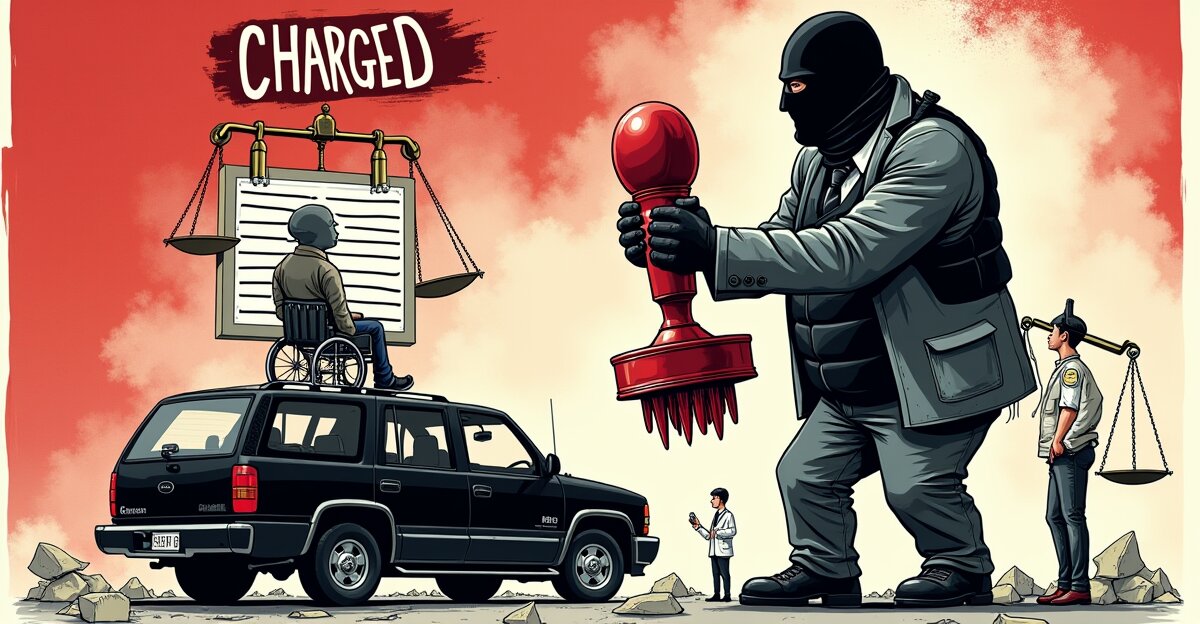
The man ICE shot in Austin is now facing up to 20 years in prison for assaulting the government that shot him.
"Rather than provide the life saving medical care he needs, DHS and the government are playing games with his life."
— Kate Lincoln-Goldfinch, attorney for Wilber Garces Perez
On a Sunday in late September, Wilber Rafael Garces Perez was doing the most ordinary thing a 28-year-old does in North Austin: picking up a DoorDash order. The government's own criminal complaint concedes as much: he was not a target of any investigation. He was between deliveries, parked outside a restaurant with his flashers on, when an ICE officer ran his plate, found a final order of removal, and pulled up behind him.
What happened next is the question this case has become. In the version federal prosecutors offered, the conversation was "pleasant and not aggressive." Then Garces Perez ignored orders to put the car in park and step out, closed his window, drove off, struck an agent in the torso with his side mirror, and led officers on a high-speed chase through commercial and residential streets. When an officer caught up and Garces Perez allegedly tried to hit him with the car, the officer fired.
In Garces Perez's account, the unmarked SUV cut him off and struck his car during the initial stop. He declined to get out, he says, because he wanted to park so his wife could retrieve the car. The chase ended, he says, when the SUV struck his car, spun it around, and an agent fired through the back right window, hitting him in the upper back.
The shooting was not captured on any body camera. The agent who fired was not wearing one. His partner's camera captured the stop, then was switched off mid-chase, after losing sight of the pursuit. Three gunshots are audible on video recorded by an off-duty Austin police detective.
Translation: every camera that was on caught the stop. Not one caught the shots.
The complaint also contains no account from the agent who fired. The case rests in part on his partner's memory of a phone call made after the shooting, and the body camera stills in the filing, defense lawyers note, do not establish the alleged mirror contact. The Austin Police Department's Special Investigations Unit and the Texas Rangers are investigating, and neither officer, identified in court records only by the initials L.G. and D.F., has been publicly named.
Meanwhile, the man they shot was not being treated like a victim. Garces Perez was taken by ambulance to Dell Seton Medical Center, where, per his lawyers' filings, his wife and attorney were not allowed to see him. He was back in ICE custody the same day. Court filings state he slept on a cement floor at a temporary processing center that night, then was hauled at 4 a.m. on September 28 to the South Texas ICE Processing Facility in Pearsall, a detention center in rural south Texas.
The bullet is still in him, lodged near his spine, and specialists have recommended surgery to remove it. For ten days, the government did not do it.
From a facility-provided tablet, Garces Perez told a press conference he had received no medication and was "losing feeling on the left side of his body." Per his attorney, guards then confiscated the tablet, revoked his communication privileges, and moved him to an isolated room with a flat bed that cannot be adjusted. DHS has disputed the accounts of his medical treatment and has not said when the surgery will happen.
His lawyers say he entered the country in 2024 with a valid work permit to seek asylum, to support his son in Venezuela, who has a mobility disability requiring expensive physical therapy. They say the program he used was ended on the first day of the current administration, and that the removal order he now carries was signed in his absence, after a hearing he missed because the notice went to an old address. DHS has countered that his work authorization expired in 2025. The dispute frames everything: in one telling, an asylum seeker who missed a letter; in the other, a man fleeing a final order.
Nine days after the shooting, the government reframed the entire story. On September 29, federal prosecutors charged Garces Perez with assaulting, resisting, interfering with, and impeding a federal officer, a federal crime carrying up to 20 years in prison.
His lawyers learned of the charge because he never showed up for a 7 a.m. call. He had been moved, without their knowledge, to the Austin federal courthouse for an initial appearance on a charge no one had told them existed. When Lincoln-Goldfinch finally saw him, he was, in her words, "emotionally distraught" and "in so much pain." Dizzy, lightheaded, wincing, unable to put on his translation headphones, he could not believe this was happening to him.
The criminal case also derailed a habeas corpus hearing that afternoon in San Antonio, where his attorneys had been moving to block his removal. The immigration case is on pause. The criminal case is moving. The only person in this story charged with a crime is the only person who was shot.
And the statute itself is far from obscure. A Reuters investigation found at least 655 people prosecuted nationwide under this assault-of-an-officer law since the summer of 2025, more than double the same period a year earlier. Lincoln-Goldfinch says the charge "is not an isolated case" and "is often used against protesters and resisters against the government." In this instance, it has been aimed at a patient.
On Wednesday, September 30, Garces Perez rolled into his detention hearing in a wheelchair, the bullet still in his spine. A federal judge found him a flight risk, found probable cause, and denied bond. He remains in custody.
In that hearing, body camera footage was reviewed in court. It shows one officer calling for a Texas Department of Public Safety dispatch, then switching his camera off before calling the other ICE agent, the one investigators say fired the shots.
In North Austin, the aftermath has its own docket. Protests have been held at the shooting site every day since September 20, and at least six people were arrested at the first one. An Austin City Council candidate was arrested on September 26 while walking his dog and charged with "rioting." Toast Lopez, a neighbor who heard the gunshots and ran over to help, says an agent pointed a gun at him the moment he crossed the street. He has been at the site every day since. "I don't want to see him disappear into the system like I've seen many others," Lopez said. "That's one of the reasons why I've been at the site every day, making sure no one forgets Wilber's name."
Reps. Joaquin Castro and Greg Casar have called for an independent investigation and his release for medical care. Casar, who visited him in detention, says a specialist recommended surgery. The shooting happened in a state where average daily ICE arrests have more than doubled, from 85 under the previous administration to 176 now, and where Governor Greg Abbott's Operation Lone Star has spent more than $11 billion on border enforcement. Vladimir Herrera of Dare To Struggle Austin, a grassroots anti-enforcement organization, says masked plainclothes agents sit in unmarked cars around North Lamar, waiting to pull people over. "More people should be thinking about what we're seeing now as the beginning and not some climax," he said.
There is a theory of this case the government never has to defend, because no one in the government is charged: that a delivery driver stopped by unmarked SUVs on a Sunday, who declined to leave a car that had just been struck, who was spun around and shot through the rear window, is the criminal here. The complaint needs him to be one. The bond ruling needed him to be one. The 20-year ceiling needs him to be one.
The cameras will settle it, eventually. The investigation will produce its reports, the full footage will surface in discovery, and someone will have to explain why the agent who fired was the one without a body camera. Until then, the government's version of events is a phone call remembered by a man who was not there, and the victim's version is a man in a wheelchair with a bullet in his back, denied bond.
The question was never whether a 28-year-old delivery driver struck an officer or was struck by one. That is what footage is for. The question is what happens when the state is both the shooter and the prosecutor, and the only witness to the shooting is the state itself. In Austin, that man's name is Wilber Garces Perez. He has a bullet in his spine, and the government wants 20 years for the trouble he caused.
Comments (0)
No comments yet. Be the first to speak up.
Join the Riot
Login with Google to leave a comment.
Login to Comment