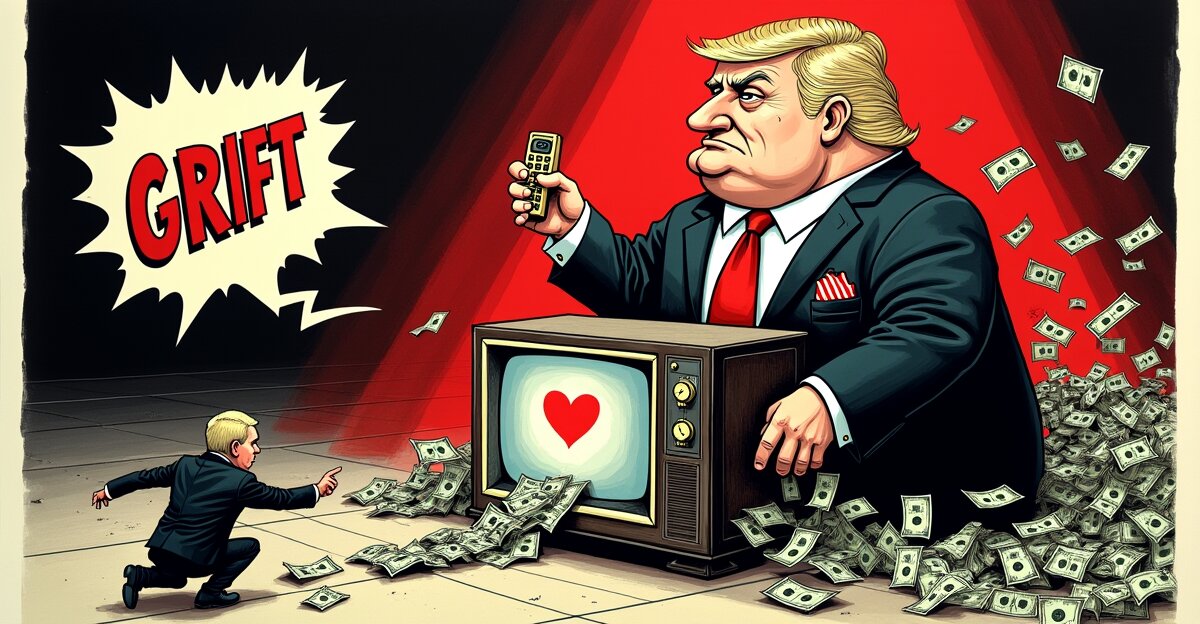
The White House calls the $443,000 commercial a public service, and the soundtrack says "love me."
"Together we will defeat communism, socialism and Marxism in America. America will never be a communist country."
— President Donald Trump, audio from a 30-second television advertisement paid for by the U.S. government
Somewhere in New York, Los Angeles, Miami, or Washington, a viewer watching Fox News this week found, wedged between the segments, a commercial with a twist: it was produced by the White House, paid for with federal money, and the final ten seconds carried the disclosure that honest advertising is supposed to prize. "Paid for by the US government."
The spot runs thirty seconds. Trump's own voice says, "Together we will defeat communism, socialism and Marxism in America." A flash-frame montage of the president flickers across the screen while a chorus, lifted from a song called "Love Me," sings over it. On-screen text rolls in: "LARGEST TAX CUTS IN HISTORY." "REIGNITING AMERICAN MANUFACTURING." "DEFEND LAW AND ORDER." UFC CEO Dana White closes with the same line he used in 2024: "This is the toughest, most resilient person that I've ever met."
CBS reporter Jim DeFede captured the ad in Miami and posted it. AdImpact, the firm that tracks political advertising, confirmed that Fox ran it in New York, Los Angeles, Miami, and Washington, and that Newsmax ran it in Chicago. The Associated Press puts the tab at at least $443,000 so far. That is what it costs, at current rates, to sell a country on its own president in thirty-second increments.
The White House's answer, issued Friday under the headline "Presidential Public Service Announcements Are Nothing New," opens by calling the criticism "highly dishonest." The ad, the statement insists, "is very clearly not campaign ads." President Trump is not on the November ballot, and there is no call to action. The announcements are "a reminder for Americans to love their country and know why it's worth defending."
Then the statement does what defenses do. It reaches for precedent. George W. Bush bought Super Bowl airtime for an anti-drug spot. Barack Obama's administration advertised savings on health insurance. Joe Biden's "We Can Do This" campaign drove vaccine signups. Woodrow Wilson's Committee on Public Information printed posters. Franklin D. Roosevelt's Office of War Information produced films. "When prior Administrations utilized the airwaves," the White House wrote, "it was called 'public education.' When this Administration promotes pride in our country, many of those same voices call it 'propaganda.'"
The problem with the precedent list is the one detail it never mentions. The Bush drug ad never showed Bush. The healthcare.gov ad never showed Obama. The vaccine ad never showed Biden. Not one of the ads the White House cited featured the sitting president, let alone filled the frame with him. This one does. Slow the montage down and every flash frame is Trump: commanding a military raid on Venezuela, hosting a state dinner for the Saudi crown prince, accepting the Fifa peace prize, pardoning a turkey, announcing a class of navy ships named for himself, showing Cristiano Ronaldo his presidential walk of fame, addressing McDonald's owners.
Translation: the public service on offer is a thirty-second montage of one man, and the invoice was sent to every taxpayer.
The legal complaints are already moving. Representative Jamie Raskin of Maryland, a constitutional law scholar by training, wrote that the ad "may be felony criminal theft and conversion of government property for political campaign purposes," and a Hatch Act violation for any government employee who worked on it. Senator Patty Murray, the vice chair of the Senate Appropriations Committee, wrote Chief of Staff Susie Wiles that the ad is "the sort of government propaganda one might expect in North Korea, not the United States of America," citing a rider in this year's appropriations law that bars government funds for "publicity or propaganda purposes within the United States not heretofore authorized by Congress." Public Citizen filed a complaint with the Government Accountability Office. Its co-president, Lisa Gilbert, made the case in one line: "Taxpayer funds cannot pay for partisan political propaganda. These ads should immediately be pulled from the air."
The "no call to action" defense only works if you do not know what the president has been telling his base. At the Republican midterm convention in Dallas this month, Trump had the crowd recite a pledge of allegiance to him and told supporters to treat November as if he were on the ballot. Emerson polling released this week shows Democrats ahead on the generic ballot. The commercial, in other words, is not a neutral reminder to love the country. It is the same argument, pre-airing: the country, the party, and the man, treated as one product.
That is the heart of it. A thirty-second spot cannot say "vote Republican," so it says everything else at once.
Two details make the ad stranger still. The first is the music. "Love Me" is a song by JMSN, a Detroit artist who was never asked. He says it was used "illegally," and that he "would never authorize my music to be used for ANY political agenda or campaign. I am looking at lawyers handling this." The White House has not said it paid for a license. The second ad, a Newsmax spot built from the president's July 4 address at Mount Rushmore, ends on "This is only the beginning of the golden age of America."
The second detail is timing. The ad hit the air the same week Trump hosted Xi Jinping, the head of the world's largest communist country, for a state visit that included a tour of the National Archives and a lavish state dinner. Defeating communism, socialism, and Marxism is a fine message for a commercial, at least as long as the top communist leader on the planet is in town, watching the same television.
The only nonpartisan part of the ad is the part about communism.
The White House's lineage argument is, in a way, honest. Wilson's Committee on Public Information and Roosevelt's Office of War Information were the original American propaganda machines, and they worked: they sold a war to a population that had not yet volunteered for it. What the statement does not say is what separates a wartime information campaign from a midterm advertisement that claims to be neither. A propaganda machine aims somewhere. The Office of War Information aimed at Germany. This machine aims at the living room, at the viewer, six weeks before an election the president is not running in but is managing with the energy of a candidate.
A public service announcement is supposed to hand you something you can use: boil the water, wear the seat belt, report the fire. This one hands you a feeling, and a bill. The White House says the ad is "aimed at the country, not a line on the ballot." But in November the country and the ballot are the same machine, and everyone involved knows it. The public service on offer is not information. It is a down payment, the government buying a little love on the public's tab and hoping no one checks the signature by election day.
Comments (0)
No comments yet. Be the first to speak up.
Join the Riot
Login with Google to leave a comment.
Login to Comment