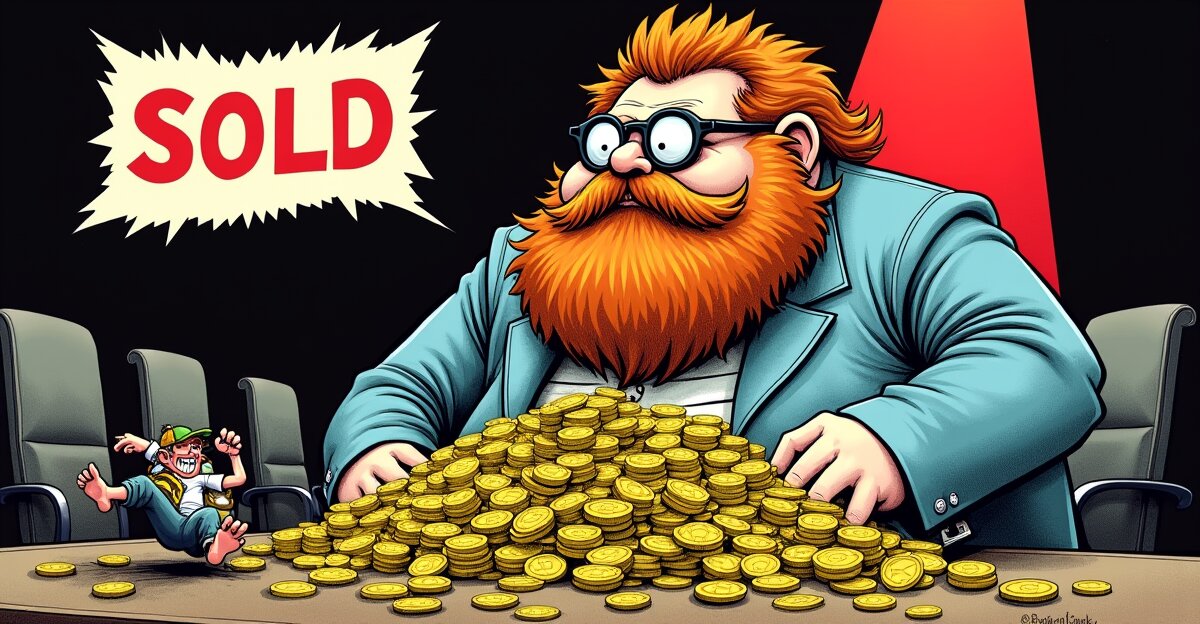
The singer who has sold more records than almost anyone of his generation was offered a choice between a friend and a tour. He chose to lose the friend. Then, one by one, he lost the rest.
"Money doesn't give you the right to own the conversation. Nobody's bank balance should decide who gets to speak or which suffering we're allowed to acknowledge."
— Lukas Forchhammer, lead singer of Lukas Graham, on quitting Ed Sheeran's tour
On a Tuesday in September, the Loop Tour, the biggest tour of Ed Sheeran's career, became something close to unprecedented in modern music: a headline act with no opening acts. Not one. Not because of injury, visa problems, or a scheduling clash, but because a single billionaire decided, in a single conversation, that one sentence was too dangerous to be sung in a stadium.
The sentence was spoken on September 4 at MetLife Stadium in New Jersey. Macklemore, the Grammy-winning rapper opening for Sheeran, stopped mid-set and gave the crowd a two-minute address. "The people all the way in Gaza to the occupied West Bank know that we have not forgotten about them," he said. "I say free Palestine. I say free Lebanon, free Cuba, free Congo, free Sudan, free Iran." He then played "Hind's Hall," a song dedicated to Hind Rajab, the five-year-old girl killed by Israeli forces while trapped in a car in Gaza. The title references a building on Columbia University's campus that students occupied in 2024 and renamed in her honor.
The machinery moved within days. The Israeli-American Council launched a petition to remove Macklemore from the tour. And Robert Kraft, the billionaire owner of the New England Patriots and a prominent donor to Israel, told Sheeran that Macklemore would not be allowed to perform at Kraft's Gillette Stadium outside Boston. According to Macklemore, Kraft did not stop at his own stadium. He rallied other stadium owners, who issued a collective ultimatum: if Macklemore stays on the tour, you will not be allowed to play in our venues.
Sheeran's response, a multipage Instagram post, reads like a press release drafted by a law firm. "I am appalled by the conflict between Israel and Palestine. The suffering and pain caused on both sides is a human tragedy," he wrote. "I have spent this week trying to build bridges, to find a solution and unfortunately, was unable to do so." And the sentence that will define the story: "Macklemore coming off tour was the promoter's decision, it was not mine."
In an earlier statement, he had explained the silence that preceded all of it in the language of a man who manages risk: "There is a reason I do not use my professional platform for politics, my audience includes young people, often children, of all backgrounds."
Translation: neutrality, priced per ticket.
The music industry does not let such things rest. On Tuesday afternoon, Finneas, the American singer-songwriter scheduled to open six South American dates in November, dropped out. "Artists must not be silenced when they speak up for the oppressed," he wrote. "I stand with Palestine and its people." Aaron Rowe, the Irish singer booked for ten of the remaining North American dates, followed hours later. "Ed has been a friend to me and has changed my life, I could never thank him enough for this," Rowe wrote. "But as Irish people we know all too well about genocide, forced famine and violent occupation. I cannot stand by and allow billionaires to use their position of power to silence the rightful voices of those who speak up against Israeli genocide and who highlight the savage murder of children. I would lose all respect for myself to carry on as normal."
Beoga, the traditional Irish band that serves as Sheeran's backing group, a friendship of more than a decade, quit in protest of "the silencing of Macklemore by zionist lobbies." The Danish band Lukas Graham was last, bringing with it Forchhammer's line about bank balances. By the end of the day, the Loop Tour had no openers left, and its North American leg kicks off Saturday at Lincoln Financial Field in Philadelphia.
Sheeran, for his part, has not canceled a single show. He will likely find scab artists willing to step in. The tour survives. The rest of him retreats.
The sharpest criticism has come not from activists but from the memory of what the same man did in 2022. When Russia invaded Ukraine, Sheeran played a benefit concert, routed proceeds from a "2step" remix to Ukrainian humanitarian aid, posted "To all Ukrainians, I love you, I stand with you," and recorded a music video with Antytila, a Ukrainian military rock band. The silence on Gaza was not an accident of temperament. It was a choice.
Ms. Rachel, the children's entertainer with tens of millions of subscribers, put it in a line that has been circulating all week: "Imagine being a Palestinian kid and seeing he did a concert for Ukraine but when over 20,000 Palestinian children are killed he's silent." Human rights lawyer Prabha Nandagopal framed the pattern more cleanly: "So neutrality was never really neutral. It was selective. One cause got the stage, the songs and the platform. The other got a phone call, and a hugely public exit."
Neutrality, it turns out, is a product. You just have to pick the right buyer.
The chorus of reaction has been unusually broad. Roger Waters, the Pink Floyd co-founder, addressed Sheeran directly: "There are two kinds of people in this world. Some people do the right thing. That rapper, Macklemore, would be one of those people." Of Sheeran: "And there are people who are p*ks, like you, who do the wrong thing. Goodbye." Colin Kaepernick, the former 49ers quarterback whose kneeling protests ended his NFL career, said the stadium owners' behavior showed they were "willing to collude." Kehlani, the singer whose Cornell University concert was canceled last year over her pro-Palestine activism, told Macklemore: "A LOT of the venues / owners are rallied together this way."
Meanwhile, a Fox News host declared on air that "Free Palestine" is the new "Sieg Heil." The Holocaust erasure is so casual it barely registers. And it is worth remembering that Kanye West, a man who has spouted anti-Jewish slurs and released a song called "Heil Hitler," has performed at the very stadiums that wanted to ban Macklemore. The new "Sieg Heil" turns out to be the regular "Sieg Heil."
What makes this week different from the long list of celebrity cancellations that preceded it is not that people are angry. People were angry before. What is different is that the anger has a direction, and it is aimed at the coward, not just the billionaires. The logic is the same logic that helped end apartheid in South Africa, the logic of the boycott: make silence less profitable. Sheeran is not a BDS target. Nobody asked to boycott him. His own musicians did it to him, one statement at a time.
The stakes, to be clear, are not the tour. This week the United States approved a $2.8 billion arms sale to Israel that includes 40,000 one-ton bombs. A stadium show is a rounding error next to that. But the stadium is where the conversation is actually won or lost, and for three years that conversation has been policed by people with bigger buildings.
The last thing Sheeran wrote was a line almost too convenient to use against him: "I know who I am, both as a person and as an artist, and those who know my heart know my values." He was offered a choice between a friend and a tour, and he took it like a man who had never been offered anything before. He lost the friend first. Then the openers. Then the band. He still has the tour. Tickets are on sale, and the show in Philadelphia will happen this weekend, because that is the point. The show goes on. It is just that everyone who cared is now in the audience, watching a man play to empty chairs.
Comments (0)
No comments yet. Be the first to speak up.
Join the Riot
Login with Google to leave a comment.
Login to Comment