
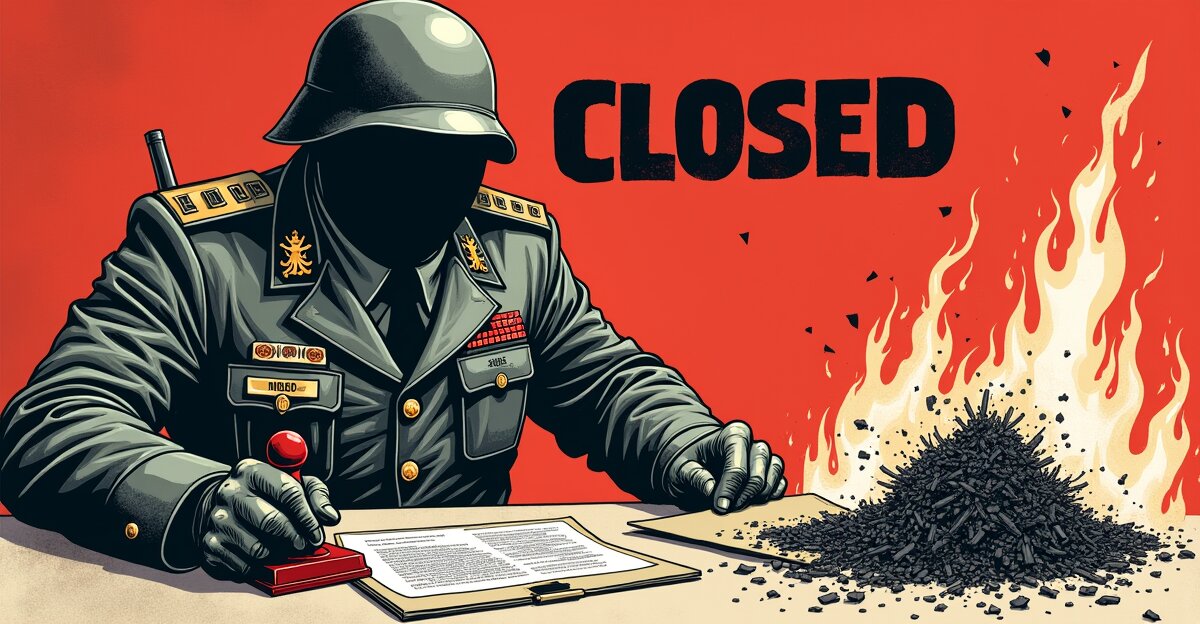
A soldier walked into a police station, confessed to killing an unarmed Afghan man, and asked to be held accountable. The Army obliged, in its way: it closed the case.
"I committed a war crime."
— A U.S. Army veteran's sworn confession to Army CID, March 2023
On a partly sunny day in the spring of 2023, a U.S. Army veteran of the Afghanistan War walked into the police headquarters in Banning, California. He had served as a specialist in the 82nd Airborne Division, the storied unit with its own mythology, in the Arghandab Valley of southern Afghanistan in 2010. In a private room in the detective bureau, he sat down with a special agent from the Army's Criminal Investigation Division, better known as CID. At 1:31 p.m. he signed a "cleansing waiver of rights." Then he told the agent what he had done thirteen years earlier.
According to criminal investigation documents obtained by The Intercept, the veteran acknowledged that he killed an unarmed man and wounded a woman. He said he "committed a war crime." He said he "needed to be held accountable for his actions."
What the man asked for was a prosecutor. What he got was a file.
The incident he described was, by his own account, unremarkable. In April or May 2010, his platoon from the 2nd Battalion, 508th Parachute Infantry Regiment occupied an abandoned building at the edge of a village, three kilometers into the valley. The Arghandab was a lush place: grape groves, pomegranate orchards, towering sunflowers, canals running everywhere, and the spiritual homeland of the Taliban. After a firefight, a unit radio intercept reported a single militant approaching on a motorcycle, transporting rocket-propelled grenades. A sniper took aim and missed.
About 500 feet away, close to twenty American soldiers raised their rifles. The veteran, then a mortarman, fired one round. Others opened fire. The motorcycle man never reached his destination.
The CID record describes what the soldiers found when they walked up: a military-age male, dead, with multiple gunshot wounds to the face and other parts of the body, so thoroughly destroyed that he was "unidentifiable." The Americans could not collect his fingerprints, iris scans, or facial images. "No RPG's were present." There was also a wounded woman, "crawling on the ground." Redactions in the documents suggest a baby or child may have been there too.
The Army never tried to identify any of them.
A man shot in the face by two dozen rifles, at a range where his weapon was not even a factor, is not what rules of engagement are designed to produce. But it is what they produced, in a war where winning hearts and minds was measured, in the field, in contact reports and kinetic firepower.
The Army's investigation of its own war crime took six weeks. An Army historian could locate no unit record of the incident, even though the unit kept detailed records for more than 100 engagements in April and May 2010. The company commander, by then a lieutenant colonel, said the incident "did not sound familiar." The unit's first sergeant said the details "sounded plausible." One soldier who never saw the man before he died speculated that the rider "sounded like" he had handed the RPG to someone before being shot. Another, by then a warrant officer, recalled that the unit "fired on the military age male on the motorcycle," found it "unfortunate that no RPGs were present," but concluded the "incident was handled properly" because "they were authorized to fire from their command team."
Nobody went to the scene. Nobody sought an Afghan witness, a family, a village. The evidence was the unit's own memory and one signed confession.
The result: no "probable cause to believe that any soldier committed the offense of murder." The case was closed.
The Army's version of due process is a system in which a man who confesses to a murder is interviewed for six weeks and told, essentially, that nothing happened.
This is not an anomaly. It is a pattern with a database. In September 2024, the In the Dark podcast, The New Yorker, and the Pulitzer Center published the largest known collection of possible U.S. war crimes in Afghanistan and Iraq that the military actually investigated: 781 cases. In at least 65 percent of the cases they analyzed, investigators concluded that no crime had occurred, even in cases where a perpetrator had confessed. In the 151 cases where investigators found probable cause, the records show 572 alleged perpetrators and only 130 convictions. Fewer than one in five received any sentence of confinement. The median sentence: eight months.
A 2020 study by the Center for Civilians in Conflict and Columbia Law School's Human Rights Institute found that most post-9/11 civilian casualty incidents go uninvestigated, and that when they are investigated, the "military too often relies solely on its internal records and sources," which can be flawed and incomplete.
The war's totals set the scale: roughly 2,400 U.S. troops dead, a cost of about $2.3 trillion, and an estimated more than 70,000 Afghan and Pakistani civilians killed as a direct result of the conflict, according to Brown University's Costs of War project. Along the way: Marines who killed 19 civilians after a 2007 ambush and were later recast as victims. A 5th Stryker Brigade "kill team" that slew at least three civilians over four months and mutilated the dead for war trophies; eleven of twelve soldiers convicted, most out of prison by the mid-2010s. Staff Sgt. Robert Bales, who massacred 16 civilians in 2012. A Special Forces A-Team accused of killing close to 20 civilians, of which the only member ever punished was the unit's Afghan interpreter.
Translation: in two decades of post-9/11 war, the system's record is not a handful of rogue soldiers. The record is the system.
Todd Huntley, an active-duty judge advocate for more than 23 years who now directs the National Security Law Program at Georgetown Law, told The Intercept that killings like the one in Banning were common. "There were probably hundreds of incidents that were just like it that we'll never know about."
The man now in charge of the war department that closed this case has his own history in the same shadow. Pete Hegseth served in the Army National Guard in Afghanistan during that era. In Trump's first term, while a Fox News personality, he lobbied on behalf of three men convicted or charged with war crimes in Iraq and Afghanistan. Trump granted two of them pardons and reversed the third's demotion. At his own confirmation hearing, Hegseth complained that "restrictive" rules of engagement made it "difficult to actually do your job on the battlefield."
Since taking over the Pentagon, which he has styled the Department of War, Hegseth has moved to dismantle the machinery that the Banning confession shows was already inadequate: replacing the Pentagon press corps with pro-administration sycophants, sidelining the top legal authorities of the Army and the Air Force, pushing changes to encourage lawyers to approve more aggressive tactics, and gutting civilian harm mitigation. A recent report from the Pentagon's top watchdog says the cuts have left the United States unable to adequately protect civilians in conflict zones. The claim was tested at the outset of the Iran war, when a U.S. attack on the Shajarah Tayyebeh elementary school killed more than 150 people, most of them children.
When pressed on congressional concerns about civilian harm, Hegseth's answer was a single line: "The Department of War fights to win." Asked if he stood by a statement that the U.S. would afford enemies "no quarter," a war crime under the laws of war, he did not walk it back.
The Banning confession punctures that posture from the inside. The 2010 rules of engagement were not restrictive. They were so loose that a man could be killed for no reason, with no record, no consequence, and no one left who could remember his name.
What remains of the case is a redacted folder and a thirteen-year delay. The veteran waited until 2023 to report the killing; by the time CID interviewed the unit, memories had faded and the records had vanished. The redactions in the documents prevent even journalists from identifying the victim or the other shooters. "If it wasn't for the soldier involved coming forward, this incident would never have come to light," Huntley said.
The man on the motorcycle never reached his destination. The woman crawling on the ground has no name in the record. The baby or child, if there was one, exists only as a blacked-out word in an Army document. And the soldier who asked to be held accountable got what the system has always had to offer: a file, a finding of no probable cause, and silence.
He asked to be held accountable. The Army held him to exactly one thing, the signature on the waiver. Everything else, including the dead, was closed.
Comments (0)
No comments yet. Be the first to speak up.
Join the Riot
Login with Google to leave a comment.
Login to Comment