
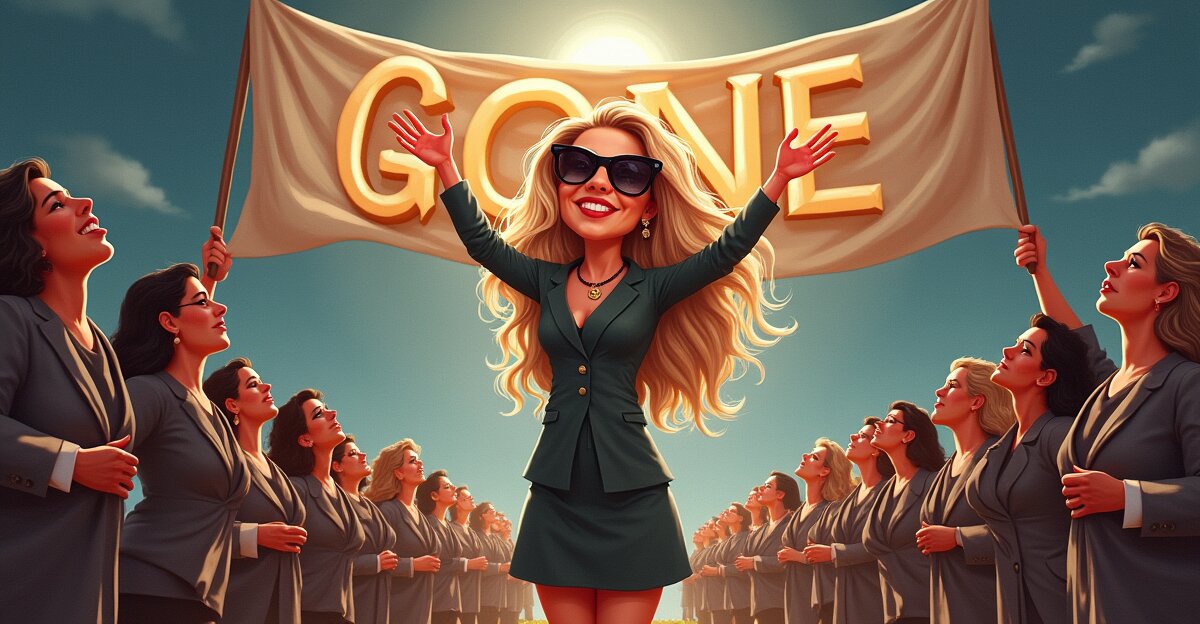
The most visible face of American feminism has died, and the thing she spent six decades building is about to be tested.
"Gloria was at heart an optimist. Her activism was rooted in optimism, and that's a moral choice, and she made it every day."
— Hillary Clinton, on "CBS Mornings," September 3, 2026
Gloria Steinem died Wednesday at her home in New York City. She was 92. The announcement, posted by the Gloria Steinem Foundation, was characteristically gentle: she "passed away peacefully, surrounded by some of the many who loved her." Her friend and fellow activist Abigail Disney, who visited her a week earlier, said Steinem was "just as funny and just as sharp as I have ever known her."
The cause of death was not given. She had been in declining health, and had recently finished a memoir for release this fall. What no one said, but everyone knew, is that the woman who spent her career telling Americans that the barrier would move, and that it always does, has now left a country where the barrier is being pushed down on a different set of women than the ones she fought for.
That is the uncomfortable part of the timing, and the one the obituaries are careful not to dwell on.
Steinem's life as a public figure did not begin with feminism. It began with a magazine assignment that she would describe for the rest of her life as a mistake. In 1963, working as a young journalist, she spent two weeks undercover as a Playboy Bunny, a costumed waitressing job in Hugh Hefner's Manhattan club. She wore a costume "so tight it would give a man a cleavage," and she reported back on the sexual harassment on the floor and the degrading medical exams behind it.
The story made her famous and, in her words, "personally and professionally a disaster." Editors stopped taking her seriously as a serious writer, and the piece would be used to mock her for decades. But it planted the seed of a larger idea. She later said she identified "with all the women who ended up an underpaid waitress in too-high heels and a costume that was too tight to breathe in," and that, in a country that reduced so many women to their outsides, "we're all Bunnies."
Translation: the joke she became was really a portrait of an economy that would rather pay women for their appearance than their labor.
The turn came in 1969, at an abortion-rights speak-out in New York. Steinem, who had had a secret illegal abortion of her own at 22 in London, heard women stand up in public and take seriously something that "only affected women," and the experience "unraveled" her. Within a few years, with Dorothy Pitman Hughes, she was co-founding Ms. Magazine, the first major publication owned, run, and written by women. Its first full issue hit newsstands on July 1, 1972, with Wonder Woman on the cover and a petition from women who had had abortions, demanding that the procedure be made safe and legal.
That was five months before Roe v. Wade.
The magazine was attacked from both sides, as the movement always would be: by the right, which claimed it denigrated "family values," and by parts of the left, which claimed it was too conservative and not radical enough. Advertisers refused to touch it. A cosmetics executive told Steinem that the women who read Ms. did not buy makeup. Car makers assumed women did not buy cars.
The numbers, decades later, quietly answered that bet. In 1972, roughly 10% of doctors, 4% of lawyers, and 1% of engineers were women. Today those figures have climbed to about 38%, 41%, and 16% respectively. Not equal, but unmistakably moved. Steinem was the first to insist that the movement's central achievement was not a single win but a slow displacement of the wall itself.
"There's a barrier that has moved, but there's still a barrier," she told CBS in 2006. "What used to be you couldn't get a job, now you hit a ceiling after a few years."
Steinem was not, by her own account, built for the work she ended up doing. She was terrified of public speaking. She had wanted to be a writer, and editors, bored with the subject of women, kept handing her assignments on food, fashion, and textured stockings. She was forced onto stages and into rallies not because she wanted the spotlight but because no one would let her do the work from a desk.
That forced visibility became her signature, and her weapon. Through her 80s and into her 90s she was traveling the country and the world, leading talking circles, keynoting marches, sitting down with strangers who came to her not for a lecture but for the thing Abigail Disney described: the "permission to be their truest selves." At 85, a few days after her birthday, she led a women's circle at an off-Broadway play celebrating her life, and one by one the audience rose to tell her their own stories of discrimination, many of them fighting tears.
She was also, to a degree that surprised even people close to her, genuinely funny about it all. Nixon, caught on an Oval Office tape, had ridiculed both her and the title "Ms." She called him "the most sexually insecure chief of state since Napoleon." When a female caller on Larry King in 1990 greeted her cheerfully before telling her to "rot in hell" for ruining "the beautiful American family," Steinem said the useful thing about the hostility was that it meant, at last, that people were taking the feminism seriously enough to hate it.
There is a part of her story that resists the hagiography. She never learned to drive, a choice that freed her to talk with whoever picked her up at the airport. She had few regrets, but she mourned that she was not present when her father died, and that she had never gotten close to her mother, the once-promising journalist who had a nervous breakdown and whom a ten-year-old Gloria was left to care for. She was "so fearful of becoming her," Steinem said, that she kept the distance.
She married at 66, to David Bale, the British activist and father of the actor Christian Bale, in a ceremony in Oklahoma. "I thought I hadn't changed, but marriage had changed," she said. He died of brain lymphoma in 2003, and caring for him taught her, she said, the difference between sadness and depression. "In depression, nothing matters. In sadness, everything matters. It makes everything poignant."
She was awarded the Presidential Medal of Freedom in 2013. She wrote more than a dozen books. She co-founded the Ms. Foundation for Women, the National Women's Political Caucus, and the Women's Media Center. And, in the final months, she was still at work, still making something, still refusing to stop because stopping, she had always insisted, was the only thing that actually made you disappear.
So here is the question that no eulogy wants to ask: who carries it now, and from what? Steinem built Ms. in 1972 to fight for the right to an abortion, and her 2022 reflection on the fall of Roe was blunt. "Either our control over our own bodies is equal, regardless of sex or race, or we're not living in a democracy." The decision she and her generation won is no longer the law of the land. The women she was talking to, and for, are now the ones being stripped of protections in real time, in courtrooms and in the streets.
Steinem's optimism, in Clinton's phrase, "was a moral choice, and she made it every day." It was never the belief that the wall would fall on its own. It was the belief that it would fall because someone kept pushing, and that pushing was not a burden but a kind of joy. "There's nothing automatic about political change, about liberation," she told CBS in 1999. "Power can't be given to you. The process of taking it is part of the empowerment."
The optimist is gone. The barrier she spent a lifetime describing, moving inch by inch, is still there. The question now is whether anyone else is willing to make the same daily choice. She would have said the answer is already in motion. She would have said that if she hadn't come along, someone else would have done the same work.
The only thing that was ever truly hers was the pushing. That part does not die with her. It just has to be picked up.
Comments (0)
No comments yet. Be the first to speak up.
Join the Riot
Login with Google to leave a comment.
Login to Comment