
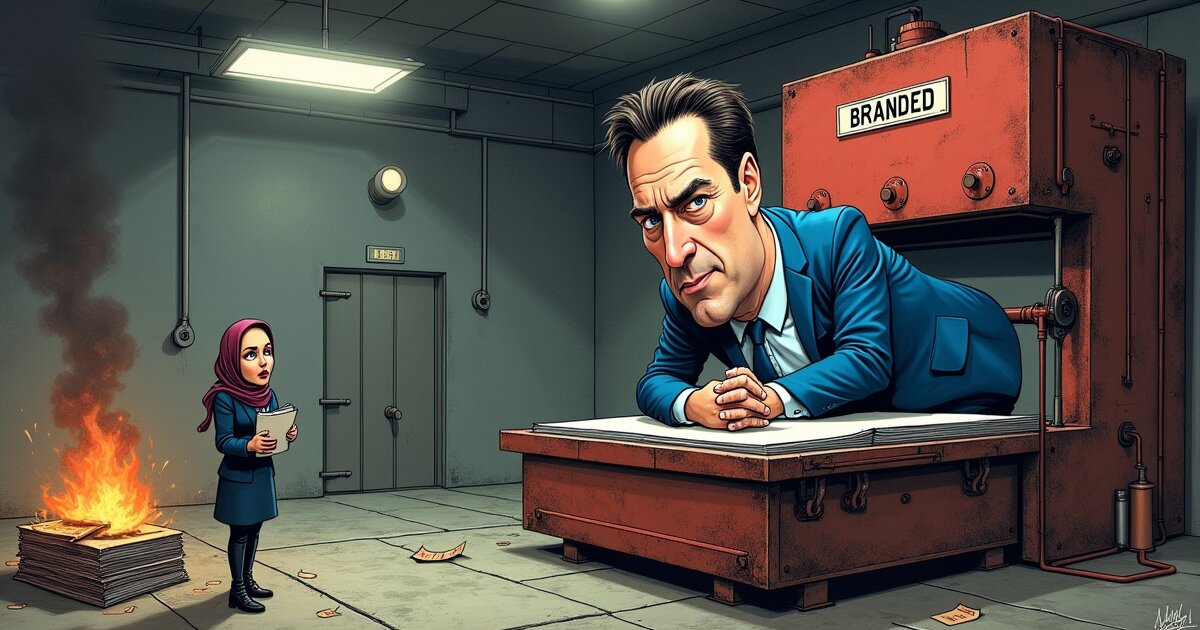
In his last months as governor, a man eyeing a cabinet seat in Washington spends thirty seconds at a state cabinet meeting stamping the word "terrorist" on the country's largest Muslim civil rights organization, without letting its lawyers finish a sentence.
"There is nowhere in that notice any allegation or evidence that CAIR has engaged in any violent or dangerous act in violation of Florida or U.S. law. And that's the first requirement for something as serious as this."
— Hina Shamsi, director of the ACLU's National Security Project
On Tuesday, September 29, a conference room in Tallahassee put on a performance of democracy. Five men sat at a table: Governor Ron DeSantis and his four cabinet members, a panel that included Attorney General James Uthmeier, Chief Financial Officer Blaise Ingoglia, and Agriculture Commissioner Wilton Simpson. Before them lay a 427-page packet submitted by the Florida Department of Law Enforcement, recommending that the state designate more than 90 organizations as terrorist. By the account of the American Civil Liberties Union, the entire deliberation took thirty seconds.
Before the vote, Hina Shamsi, counsel for CAIR, stood up and asked to speak. Under an emergency rule implementing the state's new law, the governor and cabinet have sole discretion over whether a designated organization may present arguments against the label. Notice and an opportunity to be heard, the ACLU notes, are the most basic requirements of due process. DeSantis did not acknowledge the request. He said he heard no objections from the cabinet. He approved. The packet named the Council on American-Islamic Relations, the nation's largest Muslim civil rights organization, along with its Florida chapter, the Muslim Brotherhood, the movement known as antifa, and more than 90 foreign organizations already on the U.S. government's terrorist list, including the Venezuelan crime syndicate Tren de Aragua, two Mexican cartels, and Iran's Islamic Revolutionary Guard Corps.
Thirty seconds. That is how long it took the state to answer a civil rights organization.
The vote is the final step in a project that began nine months earlier. In December 2025, DeSantis signed an executive order designating CAIR and the Muslim Brotherhood as "domestic terrorist organizations." A federal judge blocked the order in March, ruling on First Amendment grounds that the governor had exceeded his authority. The designation was paused again in July. The governor's first attempt died at the courts, so the legislature did the work for him.
In April, Republicans passed HB 1471, 80-25 in the House and 25-11 in the Senate. The law gives the state's chief of domestic security the power to designate domestic terrorist organizations, with approval from the governor and cabinet. It authorizes the secretary of state to dissolve corporations that carry the label. It creates new felonies for "assisting" a designated organization. It cuts off state funds for private schools that allow students to "promote" such groups, and bars public universities from spending state or federal money on programs or campus activities that do. Students in the state college system who "promote" a designated organization must be expelled. The law defines "promotion" as conduct that can be "reasonably interpreted" as a threat of violence, a disruption of the learning environment, an infringement of others' rights, or material support for, or recruitment on behalf of, the group. A companion measure, HB 1473, exempts the designation file itself from public records law when disclosure "would reveal information critical to state or national security."
DeSantis praised the package as a defense against "terrorist organizations that seek to infiltrate and subvert our education system." The bill also bars Florida courts from enforcing any provision of religious or foreign law, a provision aimed squarely at the Islamic code known as Sharia. CAIR, which has called the law a "deeply-flawed framework" that "can attack any organization that dares to dissent," had the point in one line.
Read the last part twice: Florida can brand a group a terrorist, then hide the file from the public.
Unless a federal judge intervenes, the designations take effect on November 5, 2026. That is two days after Americans vote in the midterm elections, and it is when the machinery starts to turn. CAIR and CAIR-Florida could be forced to shut down their operations in the state. The ACLU warns that severe criminal penalties would attach not only to the organizations but to their employees, board members, and volunteers. The filing goes one step further: under the law's design, the organizations' own lawyers could face prosecution by the state for representing them in Florida courts. A civil rights organization that cannot hire its lawyers.
Outside the cabinet meeting, Shamsi described the object of the state's fury. CAIR-Florida, she said, "carry out 'know your rights' trainings, they engage with and represent community members whose rights have been violated by government action. They speak up for and against government policies. They are representing their communities... for the benefit of the people of Florida."
CAIR has its own theory for why a nonprofit that does no violence sits at the top of a 427-page terrorism file. In a January statement, the organization questioned whether DeSantis's original executive order was retaliation for a public records request "seeking to expose possible coordination between his administration, Israeli government officials, and anti-Muslim influence networks that have worked to smear Florida Muslims and civil rights organizations."
The governor offers a different account. When the cabinet approved the implementing rule, DeSantis said the designations provide "an appropriate framework, where the state can take action appropriately to be able to defend the people of Florida against hostile actors and terrorists groups." In June, asked about the list of targets, he was more specific. "I had mentioned the Brotherhood and CAIR," he said. "But you also have antifa that needs to be taken care of."
The timing is the most damning detail. DeSantis is not running for re-election this November. In August, Lieutenant Governor Jay Collins was announced as his designated successor, ready to take over "on a moments notice." Since the spring, DeSantis has been openly positioning himself for a role in the Trump administration. In May, Trump said he would consider a cabinet position for the governor. In April, Axios reported that DeSantis had been "begging" for a prime role, including attorney general, and that the dream, by one account, is a seat on the Supreme Court.
A man who does not have to win this state's vote in November has no electoral reason to brand a civil rights group a terrorist organization. The label is a resume project: proof to a president that the governor can do the hard things.
The federal government has been moving in the same direction. In September 2025, Trump signed an executive order labeling antifa a domestic terrorist organization. In November, his administration began the process of designating certain chapters of the Muslim Brotherhood as foreign terrorist organizations, and in January the Treasury and State departments finalized designations against them. Florida's law is the state-level echo of the same machinery: a list, a label, and consequences that reach far beyond the group named. As The Intercept put it in early September, twenty-five years after 9/11, Muslims remain politicians' "favorite scapegoat." DeSantis's file suggests that scapegoating now comes with a zip code and a felony count.
The fight, now, is in court. CAIR and CAIR-Florida have sued in federal district court in Tallahassee, alleging violations of the First Amendment and the due process clause of the Fourteenth Amendment. The ACLU, the ACLU of Florida, the Southern Poverty Law Center, and a Tallahassee law firm plan to file an amended complaint and an emergency motion to stop the designations from taking effect. Shamsi's request, the one the cabinet voted down in thirty seconds, will be renewed in court, where it will at least have to wait its turn.
The rest of the country can watch from a distance, the way it has watched this governor's final act. But the calendar does the arguing. Two days after the midterms, if the courts do not move, a thirty-second vote in a Tallahassee conference room becomes the law of Florida, and the nation's largest Muslim civil rights organization wakes up a domestic terrorist, its lawyers exposed to prosecution, its members' protected speech redefined by a standard that punishes whatever can merely be "reasonably interpreted."
The question is not whether the courts will eventually sort this out. Courts sort these things out. The question is what it says about the system that a legislature wrote a law with a built-in secrecy clause, a governor assembled a 427-page file against a nonprofit that teaches people their rights, and the entire proceeding, the most consequential vote of his final year in office, took thirty seconds.
Comments (0)
No comments yet. Be the first to speak up.
Join the Riot
Login with Google to leave a comment.
Login to Comment