
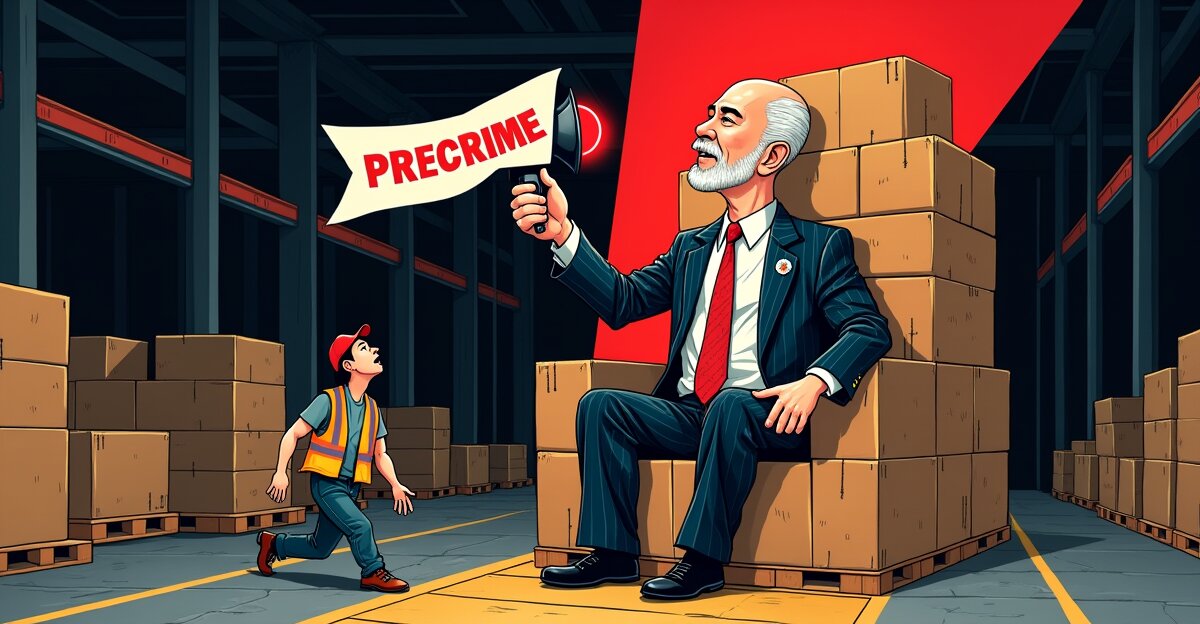
One of the richest companies in history now runs an AI that scores every warehouse for the probability of revolt, then sends in the union busters before the workers have finished making a plan.
"A labor risk framework to clarify how Amazon evaluates emerging workforce issues, labor union targets, and internal or external labor threats."
— Amazon's internal "employee relations" documents, released in a British Columbia labour board proceeding involving Unifor
For two centuries, the tools for breaking a union drive were physical: scabs, private police, closed plants, locked doors. The company with a $2.7 trillion market capitalization built something else. A batch of internal documents released in a British Columbia labour dispute reveals that Amazon operates an artificial intelligence system called Atlas. It scores every warehouse on earth for the probability that its workers will organize, and when the numbers turn red, it dispatches a "rapid response" team of union busters to the site. This is not Minority Report. This is Amazon.
The documents surfaced in a fight the union started well. In July 2025, the British Columbia Labour Relations Board certified Unifor Local 114 at Amazon's YVR2 facility in Delta, outside Vancouver, finding that the company had interfered in the union drive in an "egregious" way, including hiring new employees likely to vote no. It was the second union win at Amazon in North America, after the 2022 vote at JFK8 in Staten Island, New York. And unlike in the United States, British Columbia does not let an employer stall forever: the board ordered Amazon to recognize the union and negotiate, and first-contract bargaining began in December 2025.
It did not go smoothly. Amazon dragged its feet, and Unifor filed unfair labor practice charges. After a series of hearings, the board found the company had violated provincial labour law, including a million-dollar order over a selective pay raise the board found targeted the Delta workers. In August, the board took an unusual step and ordered first-contract arbitration at YVR2. And along the way, the legal proceedings forced Amazon to produce its internal documents in public hearings, without a sealing order. The union released them. They read like the blueprint of a surveillance state applied to a break room.
The union won. The war room just changed tactics.
Atlas, in Amazon's own words, is "a labor risk framework to clarify how Amazon evaluates emerging workforce issues, labor union targets, and internal or external labor threats." The model ingests hundreds of data points per worksite: health and safety incidents, from minor first-aid cases to serious injuries; feedback on management; tenure and turnover; completed trainings; the local minimum wage; the temperature inside and outside the building. And, crucially, proximity: how close a warehouse sits to another site already experiencing union activity.
Above all, Atlas eats speech. The system scrapes the internal "Voice of the Associate" bulletin board, the answers to the daily digital questions posed to workers, and, per the documents, even external forums like Reddit, "to understand the tenor of the discussion at the site level." An AI identifies "common keywords" so managers can "deep dive into the worker population driving the discussion." It tracks upvotes, negative reactions, and volume. The stated purpose is to let management "look around corners to identify developing themes" and "tailor strategic responses for addressing emerging risk."
Every organizing activity managers spot is logged as an "employee relations event" with a severity score. "High severity" includes the basics: workers signing union cards, delegations of workers presenting demands, protests, sickouts, work stoppages. Translation: a complaint about the bathroom is no longer a complaint about the bathroom. It is a row in a spreadsheet with a trend arrow.
Then Atlas does math. Mathematical modeling converts all the data points into a "labor score" for each workplace, and the scores are sorted into tiers. Tier 5: "no immediate perceived risk." Tier 1: "future activity is imminent." Amazon's union busters concentrate on Tiers 1 and 2. In 2024, the year the documents cover, sixteen warehouses ranked Tier 1.
One line item reads like a case study from the canon of dystopian science fiction. At LDJ5, a Staten Island sortation center across the street from the unionized JFK8, Atlas logged the leading worker concerns as "bathroom breaks, equipment, rest breaks, leadership/management, temperature." It flagged "internal activists" (read: workers) organizing, and marked the site "Risk Increase" in a bright red box. At four of the Tier 1 sites, the threat was judged high enough to send for the "rapid response" team: roving union busters dispatched to hotspots across the global network. Tier 2 sites, where activity is "highly probable," get even more personal tracking: how many workers management investigated in the past month, how many appealed, what percentage of bulletin-board comments are negative.
The pattern is simple. A warehouse where workers talk gets a score. A warehouse with a score gets a plan.
The spreadsheet is not a domestic project. One chart in the documents tracks warehouses worldwide. Two warehouses in the English Midlands, where workers have been organizing with the GMB union, both ranked Tier 1, with high volumes of negative "Voice of the Associate" posts. A warehouse in Melbourne showed a similar negative tone. Warehouses in Poland, Germany, and Italy, apparently, did not. Atlas is a global playbook answering one question: where will my people talk back next?
The B.C. documents are just the latest installment of a long pattern. In 2025, Amazon closed its DXT4 warehouse in Laval, Quebec, and pulled out of the entire province after workers there sought to unionize. When workers at a delivery-station contractor in Queens, New York, organized, Amazon cut the contractor off. At JFK8 in Staten Island, the company has refused to bargain with the union for four and a half years after the 2022 win, and still has not fully bargained even after the National Labor Relations Board ordered it to negotiate this past April.
"Amazon's own documents pull back the curtain on what workers have been telling us for years," said Justin Gniposky, Unifor's organizing director. "Behind the friendly PR, Amazon sees workers as property and treats their fundamental right to unionize as a threat to be managed and then eliminated." The workers at YVR2 are not sitting quietly while the first contract gets negotiated; in August they staged a protest at the B.C. Labour Board pressing for transparency in the case. Peter B. Olney, the retired organizing director of the International Longshore and Warehouse Union, calls Atlas "a promethean tool for union busting and the thwarting of any employee organizing," and says the labor movement must respond by finding the company's "serious vulnerabilities and choke points."
The stakes are not one contract in one province. Atlas is preemption as a labor regime: discipline before the offense, response before the event. And a surveillance system only works while people talk, so the endgame is to make talking pointless, then to make it stop. The genius of the panopticon, the circular prison with the guard tower that can see every cell, was never that the guard actually watched everything. It was that the prisoner, never knowing when the eye was open, became his own warden.
Amazon does not fear the unions it can see. It fears the union the model missed. But the documents show which direction that fear points, and it points at the workers. The question is not whether Atlas can predict an organizing drive. The question is whether a workforce that knows it is being scored will still speak at all. If the machine works, it won't. And that is exactly how Amazon wants it.
Comments (0)
No comments yet. Be the first to speak up.
Join the Riot
Login with Google to leave a comment.
Login to Comment