
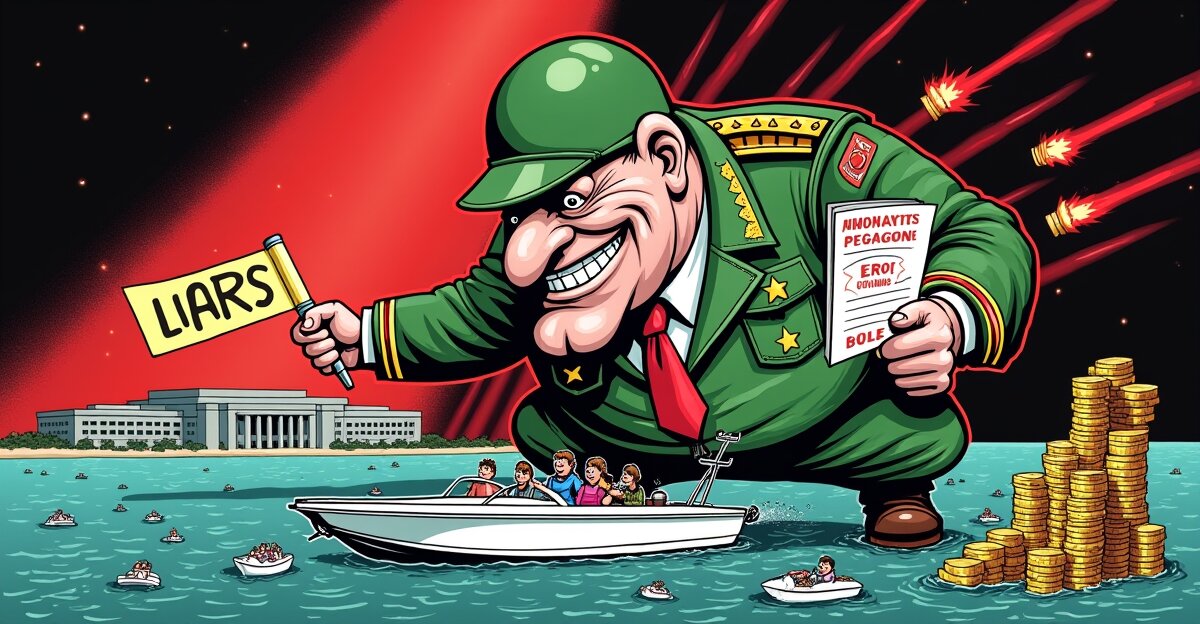
A year of American missiles into small boats on open water, and the government's own ledger insists not one of the dead was a civilian.
"The idea that 227 people are dead and not one of them is a civilian. It's a fucking joke."
— A current U.S. government official who reviewed the Pentagon's annual civilian casualty report, speaking on condition of anonymity
When the first missile hit the speedboat on September 2, 2025, eleven men were aboard. Two pulled themselves onto a piece of the overturned hull and floated in the Caribbean for about forty-five minutes, waiting for help that never came. A second missile killed them. Two more sank what was left of the boat.
That single strike began what has since become a sustained American campaign of boat attacks across the Caribbean Sea and the Pacific Ocean. It is now one year old. In that year, the United States has carried out more than sixty-five strikes and, by the most careful independent count available, killed at least 227 people. The White House and the Pentagon have called all of them "narcoterrorists."
The number the two are now willing to put in writing, officially, to Congress, is zero.
The annual accounting of civilian casualties that the Pentagon is legally required to deliver to Congress found, in the view of the two officials who saw it, that not a single civilian died in the boat strike campaign. Same report, same document, a different war: it acknowledged 153 civilians killed in the strikes on Yemen, a number one of the officials called "lowball."
The boat strikes get the cleaner number because the bodies go down with the boats, into water that Airwars, the U.K.-based conflict monitoring group, describes as "an area double the size of the continental U.S.," where "the ocean swallows up all the information we would usually rely on."
Translation: it is far easier to say no civilians died at sea than it is to say no civilians died in Yemen, where the bodies can be counted.
The legal architecture for the strikes is equally thin. A classified opinion from the Justice Department's Office of Legal Counsel, prepared with lawyers from the CIA, State, the White House, and the Defense Department, holds that the narcotics on the boats are themselves lawful military targets, on the theory that they generate revenue for cartels engaged in a "non-international armed conflict" with the United States. One official who has read the memo called it "flimsy yet expansive" and said the administration had "nonetheless managed to overstep" its own bounds.
Brian Finucane, a former State Department lawyer and expert on the laws of war, is blunter. "There is no plausible legal justification for the strikes," he told The Intercept. "They're obviously not occurring in the context of an armed conflict and outside of armed conflict, the term for premeditated killing is murder."
What makes the strikes hardest to square with any version of the law is what happens to the people who survive the first hit. Of twenty-eight survivors across the campaign, only three were successfully rescued and are still alive. In nine of eleven survivor announcements, the Coast Guard was named the primary responder.
The Intercept and Airwars found that after eight men jumped into rough seas on December 30, 2025, it took the Coast Guard almost forty-five hours to begin searching the attack zone. SOUTHCOM's own statement said it had "immediately notified" the Coast Guard to launch search and rescue. The men who needed rescue within the hour got it, if they got it at all, on the second day.
Even inside the military, doubts have surfaced. In a classified briefing last fall, Rear Adm. Brian Bennett, a senior Pentagon officer overseeing special operations, disclosed that some of the eleven men on the first boat, the September 2, 2025 strike, may have been victims of human trafficking. Senator Tim Kaine, who serves on both the Armed Services and Foreign Relations committees, reviewed the material and concluded, in a letter to President Trump, that "the available evidence suggests that the United States has killed individuals who are not involved in narcotrafficking."
Twenty-six of the 227 dead have been identified by name, all apparently men, aged between 24 and 46. A consortium of Venezuelan journalists found that among them were a bus driver, a mototaxi driver, men in fishing and the seafood trade, and a futsal player. They came from poor communities, and their ties to the drug trade were, by that reporting, "at the very lowest levels."
The administration's claim that the strikes have cut the flow of fentanyl and "saved more than 1 million American lives" has not, as of now, been supported by any evidence the Pentagon has produced.
The campaign has been rebranded as it has expanded. Operation Southern Spear has given way to "Joint Task Force Western Hemisphere," an "evolution" that folds in a nineteen-member coalition of Latin American and Caribbean governments. Secretary of War Pete Hegseth, at the coalition's gathering, described the project with the line, "We do bad things to bad people."
The strikes slowed sharply in January 2026, the month the U.S. invaded Venezuela and removed its president, Nicolás Maduro. They paused for two months in the summer, during which some of the same forces were reportedly used for earthquake relief in Venezuela, then resumed in August, quickly and by the Pacific and the Caribbean.
The most telling detail may be the staffing. The Pentagon's Civilian Protection Center of Excellence went from forty personnel in January 2025 to nine by the end of the year. The team of ten at CENTCOM that handles civilian harm at Central Command has, by one account, been reduced to a single person, the same person who still had fifteen open cases on Yemen.
Senator Elizabeth Warren and nine colleagues wrote to Hegseth in July that his "gutting civilian harm mitigation and response efforts" has left the Pentagon unable "to comply with the law and its congressionally-mandated CHMR responsibilities." The Pentagon's own inspector general described civilian protection as, in effect, inactive.
A one-person civilian harm team is not an oversight. It is a finding.
The ocean is the cleanest kind of alibi. It is wide, it is deep, and it keeps its secrets. When the government can count a bus driver among the dead and still file the incident under "zero civilian casualties," the story it is telling has less to do with the boats, the drugs, or the cartels, and more to do with how far an administration can push the distance between a killing and its own paperwork before the distance stops meaning anything.
The question is not whether the strikes were legal. The legal opinion was written to make that argument, and two lawyers' worth of government officials have already called it flimsy. The question is what "no civilians" has come to mean in a country that is now, in the words of one defense official, carrying out "a year of murders" and calling it a policy.
Comments (0)
No comments yet. Be the first to speak up.
Join the Riot
Login with Google to leave a comment.
Login to Comment