
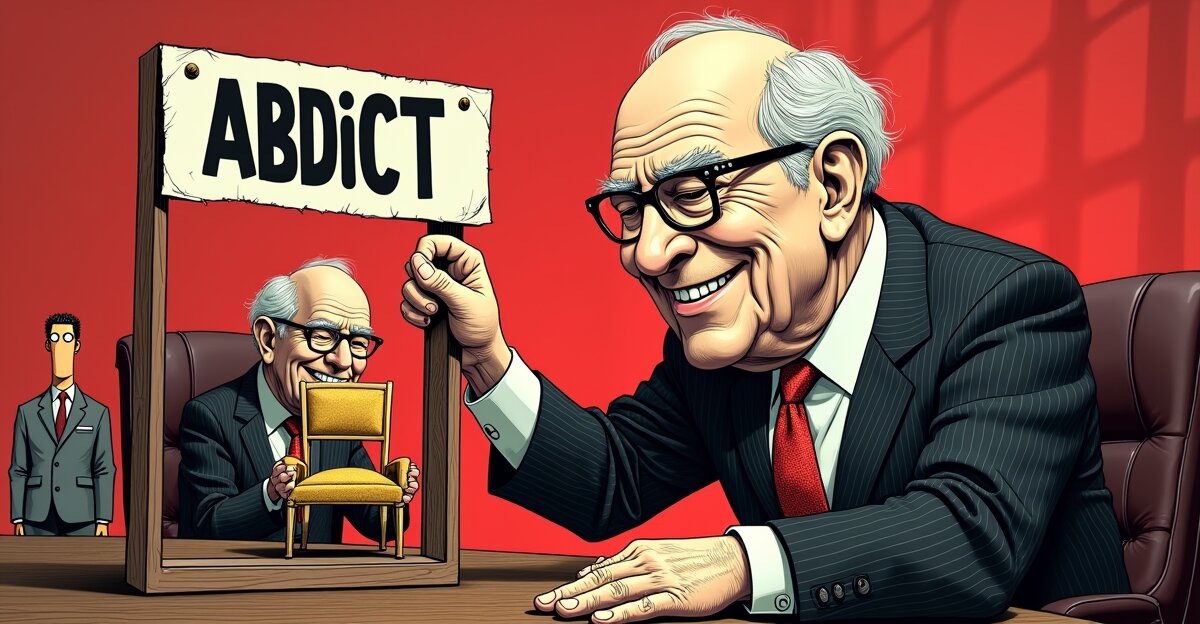
The richest investor alive just retired at ninety-six, handed the chair to his own son, and ended the last era of American capitalism in which a man that wealthy could still tell the president what he thought of his taxes.
"Think of Howard as a policy the shareholders own and hope never to claim against."
— Warren Buffett, shareholder letter, September 18, 2026
On Friday, Berkshire Hathaway published a short letter from its founder, and for about thirty minutes the most important company in American business had a new chairman. Warren Buffett, 96, is stepping down as chairman of the trillion-dollar conglomerate he took over in 1965 as a struggling New England textile manufacturer. In his place, his son Howard, 71, who has sat on the board since 1993, will take the top job. The man who actually runs the company, Chief Executive Greg Abel, stays put. And Buffett, in his customary understatement, explained why: "Father Time always wins."
He has been chairman since 1970. In the letter, he called the role "the privilege of a lifetime" and said that sixty-plus years in, he "still have[s] the best job in the world. That is not something many people my age can say, and I have never felt better about what comes next." He keeps a board seat, takes the honorary title of chairman emeritus, and says he looks forward to "remaining a shareholder alongside you."
Translation: this is what retirement looks like at the top of a trillion-dollar company. You keep the seat, the title, and the name, and you hand the chair to your son.
The handoff was staged in two acts, and anyone who knows the family can tell it was always planned. In May 2025, Buffett announced he would name Abel as his successor and said he expected to step aside. Abel, 64, took over as chief executive at the start of this year, and in the Friday letter Buffett reported that his "expectations for him were sky high from the start, and he has exceeded them." Abel "has been making the decisions that matter for some time now, and I have not had to think twice about any of them."
Then came the chair, and it went to the son, not the operator. "Greg runs the company; Howard will guard its culture and values, both worth more than anything on our balance sheet," Buffett wrote, along with a warning disguised as a joke. "Think of Howard as a policy the shareholders own and hope never to claim against."
The company has a name for its new chairman, and it is a product you hope never to use. Howard has run the Howard G. Buffett Foundation, focused on the environment and food security, since 1999, and has sat on the Berkshire board for more than three decades. He is not the portfolio guy. The money is with Abel. But the dynasty blueprint, the oldest one still in use in American business, was what got executed on Friday: the throne to the son, the operations to the professional, and everyone agreeing to call the whole arrangement a culture.
The reason this retirement lands differently from a normal 96-year-old's departure is that Buffett spent the last eighteen months doing something the current billionaire class almost never does. He told the truth, out loud, about the economics of the White House.
In March 2025, when the first tranche of 25 percent tariffs on Canada and Mexico was announced, he told CBS they were "an act of war, to some degree." "Over time, they are a tax on goods," he said. Then he added the line that did a lap around the circuit. "I mean, the Tooth Fairy doesn't pay 'em."
A month later, when the "Liberation Day" tariffs landed, he waited for the Omaha shareholder meeting, announced his own succession plans, and took a thinly veiled swipe at the trade war. "Trade should not be a weapon," he said. "Trade and tariffs can be ... an act of war." "And I think it's led to bad things. Just the attitudes it's brought out. In the United States, we should be looking to trade with the rest of the world and we should do what we do best and they should do what they do best."
The Supreme Court has since struck down the "Liberation Day" tariffs, but the invoice keeps arriving, in gas prices, grocery prices, and, as of this week, interest rates. The man who told the American public who actually foots the bill for the tariff regime is now, in his own word, just a shareholder.
He walked out of the room at exactly the right moment. Every line he drew is somebody else's ammunition now.
The numbers behind the name are what make this a period ending instead of a succession. Under his watch as chief executive, Berkshire returned 19.9 percent a year, compounded, against 10.4 percent for the S&P 500, nearly double. He turned a failing textile company into a trillion-dollar holding company spanning insurance, rail, energy, and retail, and his quarterly filings on what the company bought and sold still move markets, because for sixty years, the man was believed.
And he gave away much of it. Buffett has donated roughly $66 billion in stock since 2006, and his estate plan pledges the overwhelming share of his remaining holdings to charity, leaving his children trusts with a lot of paper and little control. Forbes pegs his fortune above $140 billion. He remains the tenth wealthiest person on the planet, and he calls his job the best in the world.
In an era when one president opens a bank with his name on it and another sells out his friends so a billionaire can sell tickets, there is something almost unbearable about watching a man compound money for sixty years, give most of it away, and hand the rest to his son. Not because the old way was virtuous. It wasn't. It just had a standard.
That standard is what goes out the door this week. The last old-guard titan had three habits, and all three are now extinct. He built the most admired company in America for half a century. He spoke to a president's policies without a press release and without fearing he'd lose a contract. He treated philanthropy as an exit, not a brand. The new oligarchs don't do the speaking part. They do the hosting part, the Rose Garden dinners, the photo ops, the quiet phone calls. They watched Buffett and learned that you don't have to be the smartest man in the room. You just have to be the one the president calls.
"Father Time always wins," the letter says, and on that point the 96-year-old is right. Time took the job, the chair, and the title, and it will take the man, too. But time also leaves a vacuum, and what fills it in a boardroom is a different question from what fills it in the world.
The question isn't whether Berkshire survives without him. It will. Greg Abel is already making the calls, and the machine doesn't care who signs the letter. The question is what American business does with the silence where the Oracle used to be, and whether the men who now gather in the Rose Garden noticed that when the last man who called a tariff an "act of war" retired to emeritus, he took the standard out with him.
Comments (0)
No comments yet. Be the first to speak up.
Join the Riot
Login with Google to leave a comment.
Login to Comment