
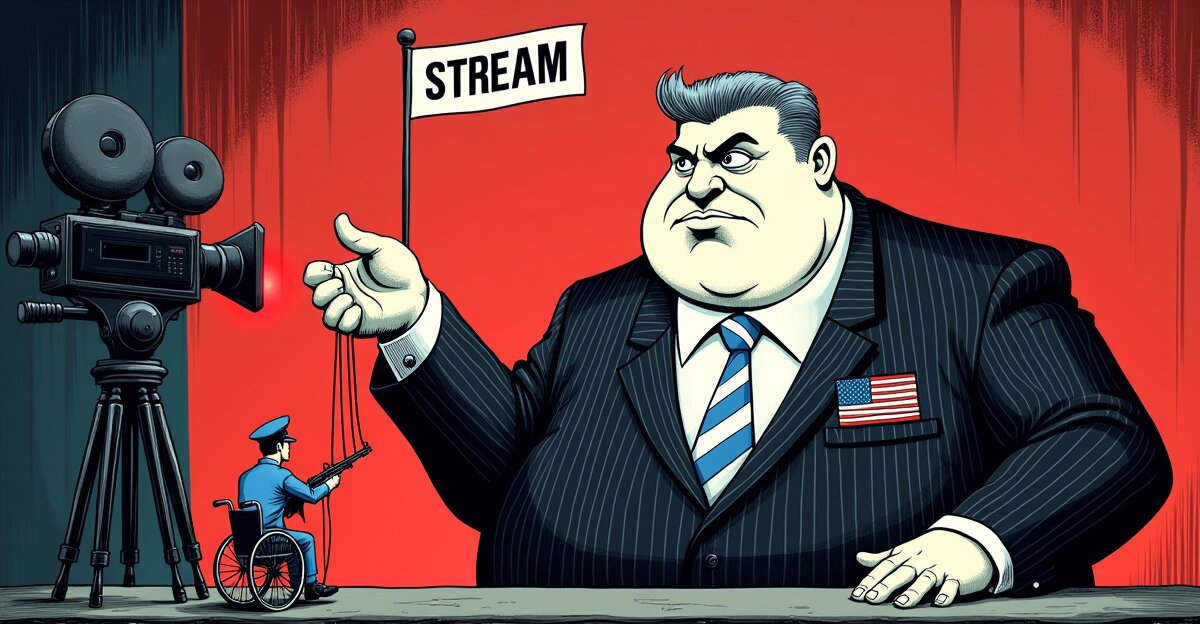
For the first time since 1936, the American state is asking its citizens to watch a man die on camera, and the soldiers holding the guns are looking for an exit.
"We'll make sure people are able to watch it, that it's public, because people need to understand that there's serious consequences for these types of things."
— Pete Hegseth, to Real American News, October 8, 2026
The announcement did not come from a Pentagon podium or a written statement. It came from a podcast. On October 8, Secretary of War Pete Hegseth, sitting across from right-wing host Jack Posobiec, casually informed the American public that the December 3 execution of Nidal Malik Hasan will be livestreamed. The first U.S. military execution in 65 years will be carried out by firing squad, at Fort Hood itself, the site of the 2009 massacre where a memorial to the 13 killed now stands, and the condemned man will be shot in a wheelchair, because he cannot walk.
Hasan, 56, was an Army major and a combat psychiatrist. On the morning of November 5, 2009, at Fort Hood, Texas, he opened fire on soldiers preparing for deployment to Iraq. Thirteen were killed. Thirty-two were wounded. He was shot by a police officer as he tried to drive away, which is how he ended up permanently confined to a wheelchair, paralyzed from the waist down. He was convicted by a military jury in 2013, his death sentence was upheld by the military's highest court in 2024, and the Supreme Court declined to hear his case in March 2025. In 2013, he told the Associated Press that he "would still be a martyr" if executed. The man the Army is preparing to kill knows exactly how the broadcast is framed.
Trump signed off on the firing squad on October 2. Army regulations designate lethal injection as the approved method of execution. A firing squad has not shot a U.S. servicemember since 1945. And according to CNN, nobody in the Army's chain of command learned of the livestream plan until Hegseth told a podcaster about it.
The legal position is, to put it mildly, strange. Federal regulations governing civilian executions expressly bar "photographic or other visual or audio recording of the execution." Army regulations for military executions cap the audience at corrections staff, the prisoner's counsel and family if requested, two media representatives, a chaplain, victims or their representatives, and nobody under 18. The last time this country put on a public execution was 1936, when 20,000 people packed Owensboro, Kentucky, to watch Rainey Bethea hanged.
A retired Army lieutenant colonel who now teaches national security law laid it out in a recent piece for the Georgetown Journal of National Security Law: the livestream plan likely violates the Eighth Amendment, and if Hasan had been a civilian, it would be flatly prohibited by the attorney general's own rules. The UN Office of the High Commissioner for Human Rights said it more plainly: "The livestreaming of an execution is tantamount to a public execution and would breach the absolute prohibition of torture."
Translation: if Hasan had been a civilian, this broadcast would be illegal.
The most entertaining part of the story is that the administration is already arguing with itself. On Friday, Trump told reporters he "absolutely" approved of the plan. By Monday, Axios reported he did not sound "particularly enthusiastic" and was "calling around, doing the Trump thing, asking people what they think." The vice president, the Catholic convert, said flatly: "I don't know that that's actually going to happen." And if it does, "I'm not gonna be watching it."
The churches moved faster than the lawyers. Archbishop Paul Coakley, president of the US Conference of Catholic Bishops and an elected conservative culture warrior, called the plan "a barbaric promotion of a culture of death and must be reconsidered." Cardinal Pietro Parolin, the Vatican's secretary of state, said it is "truly incomprehensible that anyone would want to use this method in this day and age." Pope Leo, on the World Day Against the Death Penalty, posted #NoDeathPenalty on X.
Then came the most consequential statement of all, on October 12, from the one man whose jurisdiction actually covers the firing squad. Archbishop Timothy Broglio, the archbishop for the U.S. military services, asked whether America wants to "imitate the terrorists of this world and make a public spectacle of barbarically killing our adversaries." And then: "As I would in the case of a procured abortion, I oblige any Catholics assigned to the firing squad to request to be excused from this action contrary to the teaching of the Church."
Meanwhile, Robert Jeffress, a Southern Baptist megachurch pastor in Texas, called the broadcast a divine illustration and wrote that the more people who can see "that truth illustrated through a public execution," the better. The country is, as always, arguing about the show in church.
Here is the part the coverage keeps underselling. Roughly 180 soldiers have been selected for the firing squad pool, and at least 60 of them have already asked to be excused on religious or moral grounds, according to the Military Religious Freedom Foundation. The vast majority are Christians. Their archbishop has effectively told them that shooting a paralyzed man on live television is something to be recused from.
An Army officer with multiple Middle East deployments told CNN: "It takes away everything America stands for when we do public executions. The generational harm caused by allowing troops in uniform to stand in front of a man in a wheelchair and watch him get shot to death is irreparable." A second source was blunter: "He's going to be immobile and put up like a target."
The soldiers also have a second problem nobody is talking about. If the show goes on, their faces will be on the stream. The men who carry out the order will be recognizable. Families, veterans groups, and the internet will figure out who they are. They are being ordered to aim. Nobody has told them what they get shot back with.
The stated rationale is deterrence. "People need to understand that there's serious consequences for these types of things," Hegseth said. The evidence on deterrence, even for ordinary executions, is thin. Elizabeth Bruenig, writing in The Atlantic, noted that a public execution is a proven recruitment tool for the very ideology that produced Fort Hood. Senator Jack Reed called the plan "a gift to anti-American terrorist recruiters." One of the surviving victims of the 2009 shooting said he intends to be present and "lock eyes" with Hasan. He added that the audience should be limited to victims' families and fellow survivors.
Research on public executions keeps finding what you'd expect: apathy, desensitization, and in some witnesses, PTSD. For decades, this country has condemned other governments and armed groups for public killings. The 2026 American version is the same event with better cameras.
So the scene for December 3, if it happens: a firing squad of men who did not want to be there, a condemned man in a wheelchair on the ground where 13 soldiers died, a memorial behind the cameras, and a stream.
The state that has not executed anyone in front of a crowd in 90 years is now asking its citizens to be the audience for the first public killing of a generation. The question it raised was never whether Hasan deserved his sentence. The question is whether anyone in the chain of command could say no to the broadcast. So far, the only ones who have said it are the men holding the guns.
Comments (0)
No comments yet. Be the first to speak up.
Join the Riot
Login with Google to leave a comment.
Login to Comment