
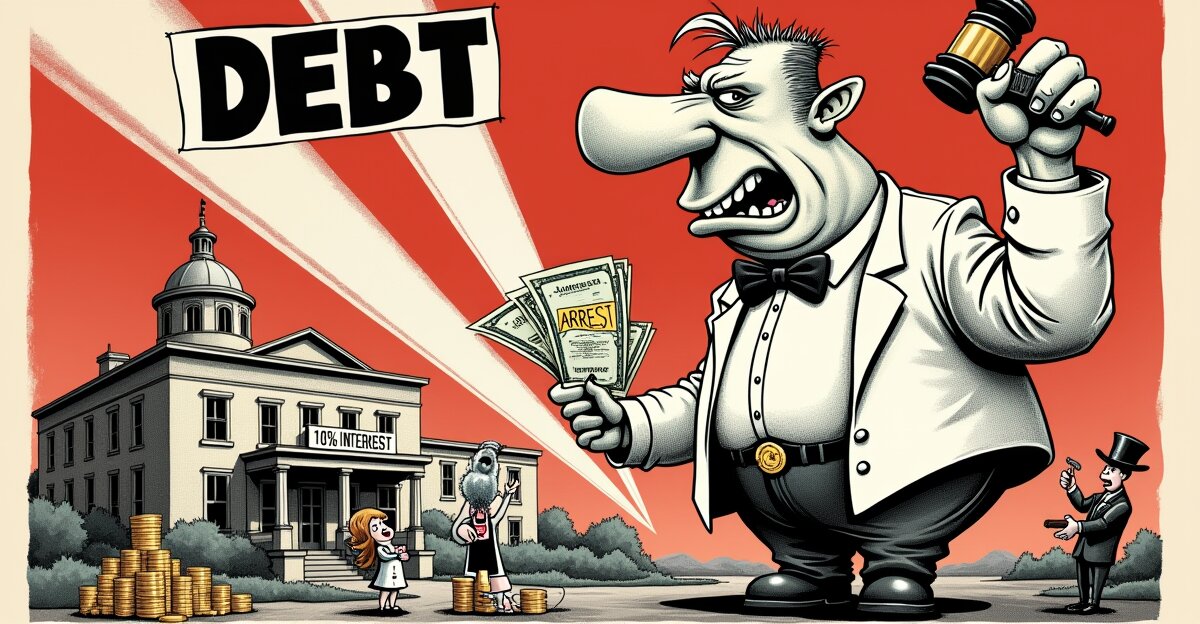
The doctor who campaigned as the trusted hands of rural Kansas sued 700 of his own patients, and in 81 cases had them arrested for the bills he wrote.
"I asked them quietly: Can you not handcuff me in front of my daughter?"
— Meischa Zimmerman, a Great Bend, Kansas mother, speaking to The New York Times about her third arrest over a $3,596 birth bill
In Great Bend, Kansas, a town of roughly 16,000 people in a flat, windy corner of the state, Sen. Roger Marshall (R-KS) built a reputation over two decades as the only obstetrician-gynecologist around. Women drove hours to his office because he was the one who accepted Medicaid, the one who was there when the ambulance arrived at 3 a.m. He was, by every local measure, the neighborhood doctor.
Court records examined by The New York Times tell a second, quieter story. Under Marshall's name, and through the practice he owned or co-owned from 1998 to 2019, his office filed more than 700 debt-collection lawsuits against his own patients. The balances were small, mostly between $101 and a few thousand dollars. But they carried an 18 percent annual interest rate, they triggered bank and wage garnishments, and in 81 cases they ended with the patient in a cell.
Marshall, who is running for reelection this fall in one of the country's most-watched Senate races, has made patient care the spine of his political identity. His campaign ad for 2020 read: "For 5,000 Kansans, life began here, in the trusted hands of Dr. Marshall." That same Dr. Marshall, the records show, sued one of those women five months after she gave birth.
The story that broke in the New York Times on Tuesday is not a story about a hospital billing department. It is a story about a single physician who, in the words of one of the paper's reporters, "used the more aggressive tactics to recoup his outstanding debts."
The mechanics matter. A patient's contract with the practice carried an 18 percent annual interest rate, higher than the prime rate at the time and above what most Kansas state laws allowed on ordinary consumer debt. When a patient could not pay, the office did not quietly write the bill off, the way most rural practices do when a family is uninsured. It sent the debt to a law firm. The law firm sued. The court set a date. The patient, sometimes already weeks or months postpartum, was expected to appear. If they did not, and this happened because several said they were never properly served with notice of the date, Marshall's lawyers asked the judge to issue an arrest warrant.
The New York Times interviewed eight affected patients. The pattern that emerges is not of debtors who refused to pay but of families who were squeezed, then squeezed again by a fee structure that compounded while they were already struggling.
Meischa Zimmerman went into labor on the night before her Medicaid application appointment. She missed the appointment. She gave birth. Five months later, the office sued her over the $3,596 balance. She tried to set up a payment plan of $50 a month. By the time the case was winding down, the bill had nearly doubled, to more than $7,000, thanks to the interest.
She was arrested three times over that bill, in 2011, 2013, and 2016. The first time, she was eight months pregnant along and at home with a two-year-old. "I had to choose whether I'd pay my electricity or pay $50 to a doctor who didn't need it," she told the Times.
In another case, Joe Vasquez, 68, and his wife were arrested over an Easter weekend in 2007 for a $4,561 balance on an emergency hysterectomy performed by Marshall three years earlier. Vasquez had fresh stitches. He was on disability. They sat in a county jail for two days until their son borrowed money to post the bond. Records show Marshall's firm formally released the judgment against the Vasquezes in 2015.
That detail is worth sitting with. The bill was eventually discharged, eight years after the arrest. The law firm got nothing out of the jail time.
Marshall's spokesperson, Payton Fuller, defended the practice in a written statement to the Times. "Judges issue warrants when people repeatedly miss court dates, not doctors," Fuller wrote. She added that Marshall provided care regardless of a patient's financial situation, that his former hospital "provided millions in uncompensated care," and that the practice "used the exact same billing and outside collection procedures as every other business or hospital in Kansas."
That last claim is the one the experts who spoke with the Times pushed back on, directly and by name.
Barak Richman, co-director of the health law program at George Washington University, said there is real variation in how rural practices handle bad debt. "There are a lot that do bring lawsuits but also a whole lot that don't. It's not because they're in a different position, they've just decided they're not going to do it," he told the paper. He described the garnishments and arrest warrants as "definitely on the extreme side." Neale Mahoney, an economist at Stanford, said research shows patients are sued in about 1.7 percent of hospital stays, and called Marshall's operations "an extreme case."
Here is where the story stops being a story about one doctor's billing habits and starts being a story about a senator.
In July 2025, Marshall introduced legislation called the Patients Deserve Price Tags Act. The bill, which cleared committee in July of this year, would prohibit hospitals from suing patients over unpaid balances if they did not publicly post their prices. It is a genuinely reasonable consumer-protection idea, and it was introduced by a man whose own practice, and the hospital he co-founded, had been filing its own suits against patients for a quarter of a century.
Financial disclosures show Marshall earned roughly $780,000 in 2015 from his practice and from Great Bend Regional Medical Center, the hospital he co-founded and served as board chair. During his time in the House, he campaigned as the physician-in-Congress, telling colleagues "I may be the only physician in Congress to help run a hospital." That positioning carried him to a seat on committees that shape the nation's health policy.
And on the Senate floor, the same Marshall voted for the One Big Beautiful Bill Act, the law that is set to strip coverage from roughly 14 million people in Kansas and across the country, many of them in the exact rural counties where his practice had been the only OB-GYN in range.
The arithmetic is not subtle. A doctor who could not stop compounding interest on a $3,596 birth bill is not, as a matter of policy temperament, the natural sponsor of a bill meant to stop hospitals from collecting on bills at all.
Marshall will face Adam Hamilton, a Leawood pastor, in November. Hamilton's campaign is already using the story, and the Kansas City Star has published its own follow-on reporting from local residents. In a town where a doctor is still remembered as the man who showed up at the hospital in the middle of a snowstorm, the revelation that the same man spent two decades suing new mothers and getting them arrested is not, to many Kansans, the story they expected from their senator.
Fuller's statement said the New York Times, "sixty days before an election, has decided that a rural doctor keeping the hospital's lights on is some kind of scandal." The framing is telling. It treats the interest rate as a matter of business judgment, the arrests as the fault of judges, and the timing as the only problem with the report.
It is not the timing that is the problem. The timing is a coincidence that the campaign cannot control. The problem is the interest rate, the warrants, the garnishments, the years. The problem is a man who told 5,000 Kansans their children were born in his trusted hands, and then spent the next two decades deciding that the cost of being trusted was an 18 percent annual fee, compounded, collected by law firm, and enforced by jail.
The question was never whether a rural doctor could be sued for bad debt. The question is why a senator who introduced a bill to stop hospitals from suing patients never once looked back at the suits he had signed off on himself.
The answer, so far, is: judges issue warrants, not doctors.
Comments (0)
No comments yet. Be the first to speak up.
Join the Riot
Login with Google to leave a comment.
Login to Comment