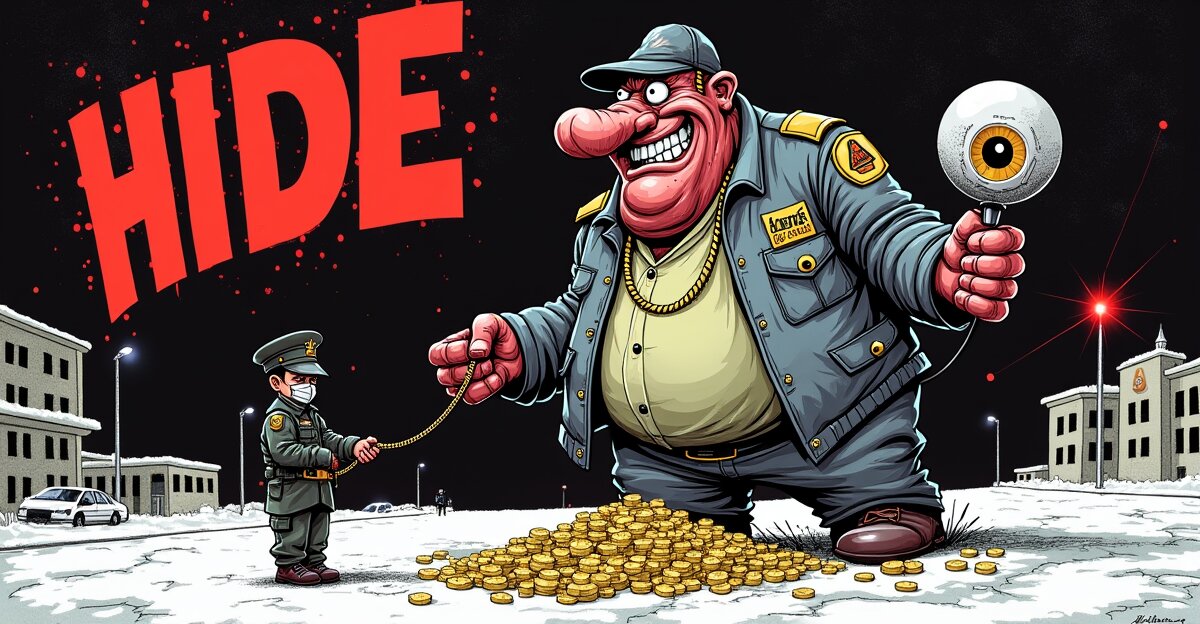
A federal agency is spending taxpayer money on AI to keep its officers unfindable, while its own employees worry the same tool will be turned on them.
"If things go sideways they may just throw all your info out there, make you out to be the problem or dox you. I don't trust it."
— An ICE official, speaking to The Intercept on condition of anonymity
The agency that shot a 37 year old ICU nurse on an icy Minneapolis street, that kept a journalist in detention for nearly a year with a festering wound, that ran a hunger strike into the ground at a Newark school gymnasium, has found a new problem to solve. It turns out the people who carry out these operations get found. Their faces end up on phones. Their names end up on lists. Their addresses, in a few cases, end up in the mouths of angry crowds. So ICE is doing what a frightened institution does. It is hiring a machine to erase itself.
According to a memo leaked to The Intercept on Monday and signed by Acting ICE Director David Venturella, the agency is launching a "Doxing Mitigation Initiative," a new program built on the AI of a company called ZeroFox. The memo describes ZeroFox as "a modernized protective technology solution designed to strengthen safeguards for our most valuable resource: You and your families." The language is the language of an HR email about dental plans. The subject is a surveillance machine.
DHS quietly awarded ZeroFox a $15 million contract in July for software licenses supporting ICE operations and the Office of Intelligence at Homeland Security Investigations. Neither ICE nor ZeroFox responded to requests for comment.
Translation: the agency that has spent a year insisting it is entitled to act without being watched is now paying to make sure no one else can watch it back.
ZeroFox is not a normal vendor. It builds AI that crawls social media and the dark web to find and map a target's digital presence, a service the company markets as a way to stop leaks before they spread. In a normal business, you buy that software to protect your customers. Here the customers are the officers, and the "leak" in question is the existence of the people enforcing a policy a majority of the country says it opposes.
The company has a past. In 2015, ZeroFox offered its services to Baltimore police for free, delivering a list it called "threat actors," a label it applied to peaceful Black Lives Matter organizers protesting the killing of Freddie Gray. When asked why the activists were flagged as physical threats, the co-founders explained that they had been labeled "physical" because they were "acting in real life" rather than online. A decade later, the FBI's own agents reportedly gave the software a derisive nickname that swapped the "Fox" for a similar sounding expletive.
A firm whose signature move is turning demonstrators into threats is now on the payroll of the agency that arrests them.
Inside the agency, the unease is loud. The ICE official who spoke to The Intercept put it bluntly. "It sounds like inside surveillance." A second official, speaking anonymously to protect his livelihood, said he was "frankly don't trust the feds" with his personal information, and was "not really keen on giving my PII to a company that doesn't have a solid track record with government contracts."
The fear is not about the machine finding criminals. The fear is about the machine finding the messenger. Richard Forno, an associate director of the cybersecurity institute at the University of Maryland, Baltimore County, described the danger with the precision of someone who has seen the pattern before. "It's plausible that this tech could be used to seek out whistleblowers," he told The Intercept. "For example, if ICE internal affairs or leadership can seed information that gets leaked, and then that information is then passed along to a reporter, you're kind of setting up a honey pot situation to figure out who the leakers are."
This is the part of the story that should not be allowed to pass quietly. A dox scanner is bidirectional. It scans the public web for a target's name, face, and home address. If the target is an ICE officer, it protects him. If the target is the employee who emailed a memo to a journalist, it protects the leak. The same algorithm, run in the opposite direction, is a whistleblower detector.
The private equity framing makes it worse. ZeroFox was bought in 2024 by Haveli Investments for roughly $350 million. Bryan Ware, who served as an assistant director for cybersecurity at DHS during the first Trump administration, is now an executive at the firm. The person once in charge of the department's cybersecurity now helps run the vendor that department is paying $15 million to hide its agents.
Sophia Cope, a senior staff attorney at the Electronic Frontier Foundation, tried to split the difference. It is understandable, she said, for a person to want to limit personal information published about them online. "However," she added, "if ICE is instituting this program to shield officers and the agency itself from public accountability, especially when information is already publicly available, then that's a serious concern and flies in the face of our democratic values."
The last clause is doing all the work. When an agent's identity is already a Google search away, a scanner that removes it from a database is not safety. It is the difference between being found by the public and being found by a federal agency.
What is quietly being described here is the completion of a loop. An agency that kills a nurse, detains a reporter, and ignites a hunger strike is no longer satisfied with acting. It is contracting for the technology that lets it act and then unact. It wants the operation to exist and the record of the operation to not exist. It wants the officer to be both present at the scene and, on the record, nowhere near it.
The memo calls the officer the agency's "most valuable resource." The line is meant to be a morale note. Read it the way the agency's own anonymous sources read it, and it is something else. The most valuable resource is the one you must keep hidden, because the moment it is found, the whole operation becomes a story that gets written.
The question was never whether a frightened agency would buy a machine to hide. The question was whether the machine would hide the officers first, or the people who tell the truth second. The ICE officials who leaked the memo already answered it. They don't trust it. They just don't know which way it will turn.
Comments (0)
No comments yet. Be the first to speak up.
Join the Riot
Login with Google to leave a comment.
Login to Comment