
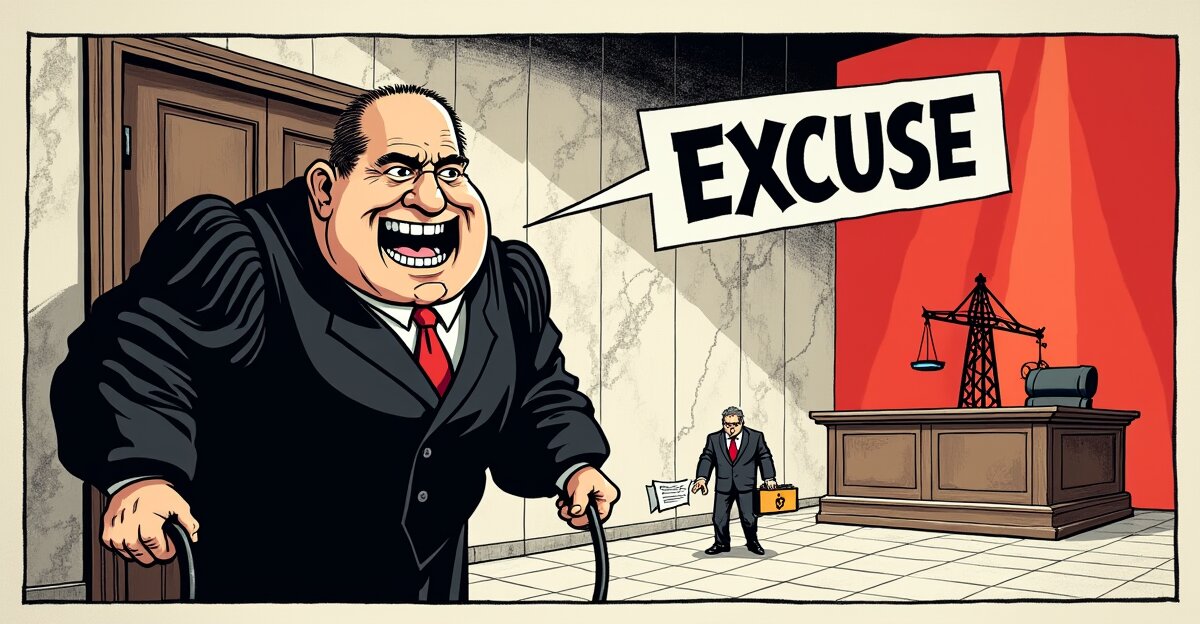
A justice with seven fossil fuel stocks in his portfolio walked out of Big Oil's most important case one week before argument, and the Supreme Court's entire explanation was one sentence.
"Justice Alito has determined that he will not continue to participate in this case."
— Clerk Scott S. Harris, one-sentence letter, September 28
That is everything the Supreme Court offered on Monday about its most consequential case of the coming term: one sentence, no reason, no apology. The letter, posted to the docket of Suncor Energy v. County of Boulder, announced that Justice Samuel Alito would sit out the oral argument now set for Monday, October 5, the opening day of the new term. It is the second last-minute recusal from a fossil fuel case this year, coming just weeks after a belated January exit from a ConocoPhillips case over wetlands destruction in Louisiana. And it lands one week before the oil industry makes its bid to end climate liability in American courts for a generation.
Alito had spent the better part of a year resisting the call.
The case at the center of all this is older than Alito's latest controversy. In 2018, the city and county of Boulder, Colorado, sued ExxonMobil and the Canadian oil major Suncor, with a straightforward theory: the companies knew for decades that burning their products would change the climate, told consumers the opposite, and should share the cost of a world that is already on fire. The suit followed the 2013 floods that destroyed 1,800 homes and tore up more than 100 miles of roadway, and the 2021 Marshall Fire, the most destructive wildfire in Colorado history. Eight years and three courts later, the case has never gone to trial.
The Supreme Court agreed to hear the companies' appeal in February, on two questions: whether federal law preempts Boulder's claims, and whether it is too early to hear them at all. Exxon and Suncor's framing was blunt. They told the court they face "billions of dollars in damages" and asked the justices to step in "to prevent dozens of climate change cases from improperly barreling ahead in state court." Eleven similar suits, brought by governments including California, New Jersey, Delaware, and eight California cities and counties, are already stayed pending the outcome. A ruling for the industry would function as blanket immunity. The Trump administration has lined up behind the appeal.
In other words, October 5 is not a hearing about one flood in one Colorado town. It is the day the industry tries to settle the whole score at once.
And then there is the portfolio. Alito does not own stock in Suncor or Exxon. His own financial disclosures, released in August, show something else: shares in more than 25 individual corporations, seven of them in the fossil fuel industry, plus a mineral interest in Oklahoma worth as much as $250,000. Two of those holdings are ConocoPhillips and Phillips 66, both of which have warned shareholders in their own filings that climate litigation poses a material risk to their earnings. A Guardian analysis in August calculated that Alito has gained as much as $2.9 million from oil and gas assets since joining the court.
Consumer Watchdog went further this month, finding that Alito holds stock in companies connected to every climate case currently stayed pending Suncor v. Boulder. The group's organizing director, Alexandra Nagy, was not subtle about it. "Justice Alito's recusal from Suncor v. Boulder is the right decision, and one he should have made from the start," she said. "The public should not have to wonder whether a justice's personal investments could benefit from a ruling that shields the fossil-fuel industry from liability."
The letter is one sentence long. The portfolio runs deep. The timing is seven days before argument. The arithmetic is the story.
The resistance, meanwhile, is well documented. In May, a court spokesperson told NBC News that Alito's counsel had determined recusal was not required. That same month, a coalition of 30 environmental and watchdog groups, including the League of Conservation Voters and the Revolving Door Project, asked the Senate Judiciary Committee to investigate whether Alito was violating the ethics code the court adopted in 2023. That code, the court's first ever, says a justice should step aside when a financial interest sits "in the subject matter in controversy."
What the code does not do is enforce itself. Stephen Gillers, the emeritus legal ethics professor at New York University, told CPR News that recusal at the Supreme Court "is often a black box. There's no need to explain why you have or have not recused." Justices decide for themselves. Chief Justice John Roberts has defended that arrangement for well over a decade, writing in a 2011 year-end report that he has "complete confidence in the capability of my colleagues to determine when recusal is warranted."
The record also shows the industry has been managing this problem for years. In 2022, Exxon told the court that the Boulder case was the "ideal vehicle" for the preemption fight, because it involved a smaller set of defendants and was "less likely to present recusal issues." Nobody named names in that brief, but the lawyers writing it knew exactly whose names would be in the room. Between 2023 and 2025, the court denied oil-company petitions on this same question in nine cases, and Alito recused himself from the conferences for all but one of them. Then, in February 2026, the court took the Boulder case, and Alito participated in the conference where the vote was cast, raising the question of whether his vote was the decisive fourth.
Translation: Exxon did its homework. The 2022 brief was not just legal strategy. It was bench engineering, a path to a full court that would include the justice with seven fossil fuel holdings.
So why now? Nobody knows, and the court is under no obligation to say. The letter gave no reason, and no justice has ever been required to explain one publicly. The charitable read is that the pressure simply peaked: a published watchdog report, a 30-group letter to the Senate, a national-media accounting of his returns, and an argument date one week out.
The less charitable read is in what did not change. Alito has not sold the stock. A biography of him released this year, by the conservative author Mollie Hemingway, explains that the holdings were inherited by his wife, Martha-Ann, and carry sentimental value that makes her disinclined to sell them. Arthur Hellman, the emeritus legal ethics professor at the University of Pittsburgh, called the arrangement baffling. "It just seems to me no emotional attachment can override all of those concerns," he said. Louis Virelli, a Stetson University professor who has written on recusal, thinks the whole framing is wrong. "The real question to me is: Why does any justice hold stock in an individual company that is part of an industry that is going to appear before the court?"
The stocks stay. The letter goes out. That is the entire compromise the system currently offers.
On October 5, eight justices will hear argument. If the bench splits four to four, the lower court's ruling stands, which in this case means the Colorado Supreme Court's 2025 decision letting Boulder proceed to trial survives, and the litigation continues in state court. A ruling for the industry, meanwhile, hands oil companies the shield they have chased for eight years, with eleven stayed cases waiting in the wings for the green light.
For years the arrangement has run like this: a justice invests in the industry, the industry picks the case that can reach that justice, the conference happens in secret, and the public gets one sentence in a docket. The recusal cleans up the appearance. It does not clean up the portfolio, and it does not reach the February conference where the case was accepted in the first place.
The question is not whether Alito should have recused himself. The question is why the deadline was the only thing that got him to do it, and why a one-sentence letter is all the public gets for a portfolio worth millions and a court that is about to decide who pays for a warming country.
Comments (0)
No comments yet. Be the first to speak up.
Join the Riot
Login with Google to leave a comment.
Login to Comment